
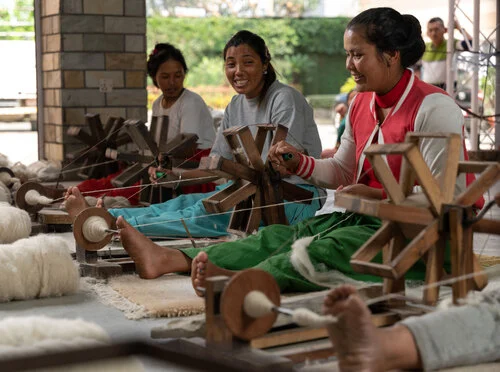
Published: June 2026 | Reading time: 12 minutes | Written by: NP Rugs Team
Your retail buyer’s compliance team has a question before they can onboard your rug product: “Do you hold GoodWeave certification?”
If you cannot answer yes – with a current certificate and a third-party audit trail to back it up – many of the largest retailers in the US and Europe will not proceed. Target, Wayfair, and a growing number of EU distributors have made GoodWeave certification a non-negotiable entry condition for handmade rug suppliers.
This guide explains exactly what GoodWeave certification certifies, how the audit process works, what it means for your import compliance and ESG reporting obligations, and how it works alongside STEP (STeP by OEKO-TEX) – the second major certification that the most serious ethical sourcing teams now expect alongside it.
Table of Contents
- What GoodWeave Certification Actually Certifies
- How GoodWeave Audits and Inspections Work
- What Happens When a Violation Is Found
- Why This Matters to Your Retail Buyers: ESG, Onboarding, and Compliance
- Label STEP Certification Explained: The Second Layer
- How GoodWeave and Label STEP Work Together
- How NP Rugs Achieved and Maintains Certification
- Questions to Ask Any Rug Manufacturer About Certifications
1. What GoodWeave Certification Actually Certifies
GoodWeave International is an independent, non-profit organisation founded in 1994. Its certification system was built specifically for the handmade rug and home textile industries, where subcontracting, home-based weaving, and multi-tier supply chains make child and forced labour difficult for buyers to verify on their own.
GoodWeave certification is built on three core principles. A certified manufacturer must demonstrate:
- No child labour – no person under the legal working age is employed in any production tier
- No forced or bonded labour – workers are employed voluntarily, with freedom to leave and without debt bondage
- Safe, documented working conditions – the production environment meets verifiable health, safety, and welfare standards
These three principles apply not just to the factory floor you visit – they extend to every subcontractor, workshop, and home-based weaver in the supply chain. This is the critical distinction that makes GoodWeave meaningful. It is not a self-declaration. It is a monitored, third-party-verified standard with physical inspections.
NP Rugs holds both GoodWeave and STEP certification - the two industry standards covering labour and environmental performance in handmade rug manufacturing.
The Scope of Coverage
When an exporter becomes a GoodWeave licensee, they must:
- Accurately report the name, location, and contact information of every production site – including all subcontractors
- Update this information with GoodWeave at least every six months
- Allow inspectors unrestricted access to every tier of their production, including outsourced and home-based units
This means a buyer purchasing from a GoodWeave-certified supplier is not just getting assurance about the main factory. They are getting assurance about the entire production web behind the rug they are importing.
Tip
Read also: How to Source Handmade Rugs Directly from a Nepal Manufacturer: A Trade Buyer’s Complete Guide
2. How GoodWeave Audits and Inspections Work
GoodWeave operates a two-track verification system. Understanding the difference between these two tracks is important when evaluating what certification actually means in practice.
Track 1: Announced Audits
Announced audits are scheduled, on-site assessments conducted by independent GoodWeave-approved auditors. They evaluate a producer’s total compliance with the GoodWeave Standard and document performance against additional “Progress Principles” – which include health and safety practices, fair wages, and freedom of association.
These audits assess whether documented systems, worker records, contracts, and welfare programmes are in place and functioning. They are the formal certification review.
Track 2: Unannounced Inspections
Unannounced inspections are the mechanism that makes GoodWeave credible. These visits happen without advance notice and are designed to catch the gap between what a factory shows during a scheduled audit and what actually occurs day to day.
Critically, unannounced inspections cover:
- The certified exporter’s primary production facility
- All subcontracted production units
- Home-based weavers working on behalf of the certified exporter
This last point matters particularly for Nepal, where the industry has historically included a proportion of home-based production. GoodWeave’s inspection scope extends into this part of the supply chain – the part that previous certification systems often missed.
Supply Chain Mapping
Before any audit or inspection takes place, the licensee is required to provide GoodWeave with a complete map of their supply chain. This includes every workshop, every subcontractor, and every home weaver. The map is updated at least twice a year.
This supply chain mapping requirement serves two functions. First, it forces exporters to understand and document their own production network. Second, it gives GoodWeave inspectors access to the full scope of production – not just the factory entrance.
3. What Happens When a Violation Is Found
If an inspector identifies a violation – including the discovery of child labour – a structured remediation protocol is triggered immediately.
The child protection response:
- The child is removed from the production environment immediately
- GoodWeave’s child protection, rescue, and rehabilitation protocols are activated
- The child is supported through family reunification, placement in a transit home (in Nepal, GoodWeave operates “Hamro Ghar” – a residential support facility), and access to education
The certification response:
- GoodWeave’s Certification Committee reviews the case
- Depending on severity, outcomes range from formal corrective action requirements to suspension or revocation of the licence
This is not a certification system that issues a label and walks away. Active violations result in active consequences – for the child and for the manufacturer’s market access.
For buyers, this matters because it means the label you see on a rug represents something that has been tested under pressure, not just assessed in ideal conditions.
4. Why This Matters to Your Retail Buyers: ESG, Onboarding, and Compliance
ESG (Environmental, Social, and Governance) has moved from corporate reporting language to supply chain procurement requirement. The change happened faster in rug sourcing than in most other home goods categories – partly because the risk of child labour in handmade textiles was documented and publicised early, and partly because major retailers acted.
Target
Target has a long-standing, public commitment to ethical sourcing for its handmade rug products. For handmade rugs supplied to Target’s private label programmes and vendor network, GoodWeave certification functions as a prerequisite – not a differentiator. It is the entry condition.
Wayfair
Wayfair’s “Shop Sustainably” programme highlights products with third-party ethical certifications. For handmade rug suppliers, GoodWeave certification is the recognised standard Wayfair references when evaluating labour compliance. Their Supplier Code of Conduct requires that human rights and labour standards extend beyond tier-one factories.
IKEA
IKEA applies its own mandatory supplier standard – the IWAY Supplier Code of Conduct – which covers environmental, social, and working conditions across the supply chain. IWAY requirements overlap significantly with GoodWeave’s labour principles and add environmental performance metrics. For a manufacturer holding GoodWeave certification, IWAY compliance assessments are substantially easier because the supply chain documentation and inspection discipline are already in place.
European Distributors
EU buyers – particularly in Germany, the Netherlands, and Scandinavia – are navigating an increasingly formal regulatory environment around supply chain due diligence. The German Supply Chain Due Diligence Act (Lieferkettensorgfaltspflichtengesetz, in force since 2023) requires companies above certain size thresholds to conduct due diligence on human rights and environmental risks across their supply chain. French and Dutch equivalents exist, with EU-wide legislation under development.
For a European distributor, sourcing from a GoodWeave-certified manufacturer is not just a moral preference – it is becoming a legal risk management tool.
ESG Reporting
For publicly listed buyers or buyers reporting against ESG frameworks (GRI, SASB, CDP, or corporate sustainability commitments), a GoodWeave-certified supplier provides documented, third-party-verified evidence of labour compliance. This is something a supplier self-declaration cannot provide.
Important
If your buyer asks for labour compliance documentation during supplier onboarding, a current GoodWeave certificate with a verifiable licence number is the correct response. A self-declaration or a factory visit report is not equivalent.
Label STEP Certification Explained: The Second Layer
Label STEP is a non-profit, fair trade organisation specifically dedicated to the handmade carpet and rug industry. While GoodWeave is universally recognized for its focus on eliminating child and forced labour, Label STEP complements this by taking a holistic approach to fair trade.
Their primary goal is to combat exploitation, improve the living conditions of artisans, and ensure that handmade rugs are produced ethically across all aspects of the supply chain.
What Label STEP Focuses On
Label STEP’s certification is built around several core areas:
- Fair Compensation: Ensuring weavers and workers receive fair wages that support a decent standard of living, going beyond minimum statutory requirements.
- Worker Welfare and Health: Focusing heavily on the health, safety, and overall well-being of the artisans who weave the rugs.
- Environmental Standards: Enforcing strict ecological and environmental standards directly within weaving villages and workshops, ensuring sustainable production methods.
- Community Empowerment: Implementing social standards that improve the fabric of the communities where rugs are made.
The Label STEP Approach
Unlike generic environmental or social certifications that apply to multiple industries, Label STEP is exclusively focused on the realities of the handmade rug trade. Their local representatives work directly in the weaving regions — including Kathmandu, Nepal.
These representatives conduct regular, unannounced audits, but they also act as partners in continuous improvement. By being embedded in the communities, Label STEP ensures that environmental and social standards are actually implemented on the ground, directly within the workshops and villages where the weaving happens.bel – a consumer-facing product label that tracks supply chain provenance and confirms both product safety (via OEKO-TEX Standard 100) and sustainable production (via STeP).
6. How GoodWeave and STEP Work Together
GoodWeave and Label STEP are complementary – they cover different dimensions of the same sourcing risk. While there is intentional overlap, each brings a specific strength to a manufacturer’s ethical profile.
| Dimension | GoodWeave | Label STEP |
|---|---|---|
| Child labour | ✓ Core focus | ✓ Strict enforcement |
| Forced/bonded labour | ✓ Core focus | ✓ Strict enforcement |
| Factory working conditions | ✓ Inspected | ✓ Audited and supported |
| Fair compensation & wages | Monitored | ✓ Core focus |
| Environmental standards | Not in scope | ✓ Strict enforcement |
| Industry focus | Rugs & home textiles | ✓ Exclusively handmade rugs |
A buyer holding both certifications from their rug manufacturer has covered the full spectrum: labour ethics verified through field inspections and supply chain mapping (GoodWeave), alongside fair compensation and ecological performance verified by an industry-specific fair trade body (Label STEP).
Neither certification alone covers everything a serious ESG procurement team needs. Together, they do.
7. How NP Rugs Achieved and Maintains Certification
NP Rugs has held GoodWeave certification continuously since our early days as an exporter. Label STEP certification provides the second pillar of our commitment, ensuring that our fair trade and environmental practices meet the highest international standards.
What Our Certification Means in Practice
Supply chain transparency: Every weaver, subcontractor, and production unit working with NP Rugs is registered in our GoodWeave supply chain map. We update this twice a year as required. If a buyer or auditor requests the full list of production units, we provide it.
Unannounced inspections: We have no advance notice of GoodWeave or Label STEP inspections. This is by design and is how it should work. Our practices and documentation are the same every day – not prepared specifically for an audit window.
No child labour policy: NP Rugs enforces a strict minimum working age policy across all production. Age verification is part of our artisan onboarding process. All artisans are adults. This is not subject to exception.
Environmental & Safety Standards: Our Label STEP certification ensures that our operations at our Kathmandu facility meet strict environmental and social standards. We use AATCC-tested chromatic dyes and natural vegetable dyes, managed safely to protect both our artisans and the local ecosystem.
Artisan welfare: Beyond certification requirements, NP Rugs operates welfare programmes for our artisan workforce – including health and safety training, fair wage structures that align with Label STEP’s fair compensation requirements, and a production environment built for the people who work in it.
Viewing Our Certificates
Current GoodWeave and STEP certificates are available to download from our Certification page. Certificate copies are provided with every commercial shipment for your retailer onboarding or ESG documentation requirements. For buyers who need certificates in advance of placing an order, contact our export team at info@nprugs.com.
Tip
Read also: How to Source Handmade Rugs Directly from a Nepal Manufacturer: A Trade Buyer’s Complete Guide
8. Questions to Ask Any Rug Manufacturer About Certifications
If you are evaluating rug manufacturers and need to verify their ethical compliance before presenting suppliers to your retailer or ESG team, use this checklist.
A legitimate certificate has a GoodWeave licence number that can be cross-referenced on the GoodWeave website. If a manufacturer claims certification but cannot produce a licence number, the claim is unverifiable.
The answer should be yes. GoodWeave’s standard requires supply chain coverage beyond the primary factory. A manufacturer who only holds factory-level coverage is not meeting the full certification requirement.
A manufacturer who cannot recall an unannounced inspection — or who has never received one — may have a GoodWeave licence that has not been actively monitored. Frequency of inspections is a credibility signal.
An honest manufacturer who has been inspected for any period of time may have had minor findings. How they were addressed matters more than whether they occurred.
STEP / Environmental Certifications
Level 1 (entry compliance), Level 2 (good implementation), or Level 3 (exemplary). Understanding the level matters for buyers with specific environmental performance requirements.
A certified manufacturer should be able to describe their chemical inventory, substitution protocols, and wastewater treatment practices in concrete terms.
This is a specific question that separates manufacturers with real environmental management from those with documentation only. A valid STEP-certified facility can answer this specifically.
Documentation
This is a practical operational question. Certifications are most useful when they are built into the shipping documentation workflow, not retrieved manually per request.
Always verify expiry dates. A certification that expired 18 months ago is not a certification.
Current GoodWeave and Label STEP certificate copies are available for download from our Certification page or provided with every commercial shipment.
9. The Bottom Line for Trade Buyers
ESG compliance in rug sourcing is no longer a premium add-on – it is the baseline for selling into major retail channels in the US and Europe. The manufacturers who hold GoodWeave and STEP certification are the ones who have had their supply chain practices tested by people who do this for a living, with unannounced visits and formal reporting consequences when standards are not met.
For a buyer, this means the work of verifying your supplier’s ethical position is substantially done before you place your first order. You get the certificate, the licence number, the audit trail – and a supplier who has institutional experience navigating the ESG requirements that your retail buyers will ask about.
The alternative is sourcing from an uncertified manufacturer, running your own supply chain audit, and carrying the documentation liability yourself.
Ready to Review NP Rugs’ Certification Documents?
NP Rugs holds current GoodWeave and LABEL STEP certifications. Both are available immediately.
Three ways to proceed:
- Download our certification documents – GoodWeave licence and STEP certificate available on our Certification page
- Request a trade sample – contact us at info@nprugs.com or through our trade programme page and we will include physical certificate copies with your sample shipment
- Speak with our export team – call +977-9765960464 (Nepal)
About the Author
This article was prepared by the NP Rugs export and trade team. NP Rugs has manufactured and exported handmade rugs from Kathmandu since 1991, supplying trade buyers in the US, Europe, and Australia. We have held continuous GoodWeave certification and STEP certification, and work with buyers whose retail partners include Target, Wayfair, and major EU retailers.
Last updated: June 2026