Understanding the difference between hand knotted vs hand tufted rugs is the most important decision a wholesale buyer makes – and the most commonly misunderstood one.
TL;DR
A hand-knotted rug has no adhesive – every knot is tied by hand directly onto the loom’s warp threads, producing a lifespan of 25–100 years. A hand-tufted rug uses latex adhesive backing, which degrades in 5–10 years in controlled environments and faster in cold, humid conditions like Canadian basements, entryways, and cottages. NP Rugs wholesale pricing: CAD $1,000–$1,300 (tufted, 8×10 ft) vs. CAD $2,000–$2,600 (knotted, same size). One knotted rug over 25 years vs. two or three tufted replacements – the math is not close. Nepal benefits from Canadian GSP tariff exemptions. NP Rugs holds GoodWeave and Label STEP certifications, both increasingly required by Canadian boutique retailers and their end customers.
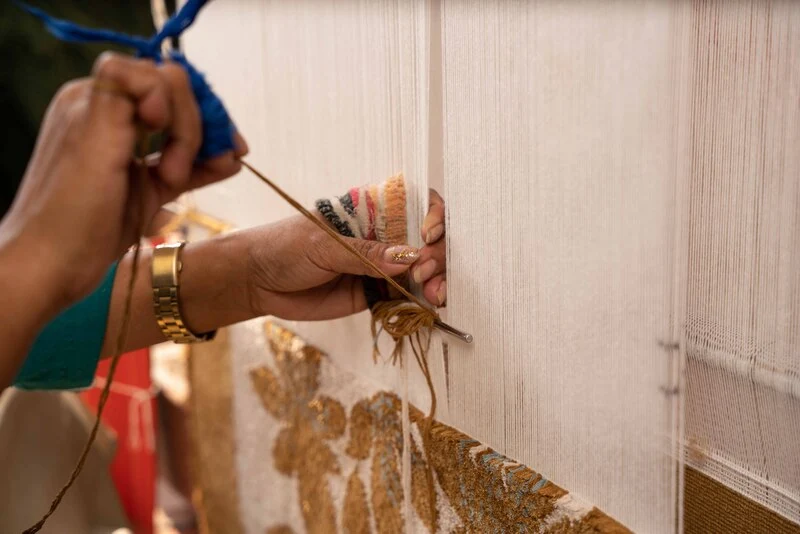
A hand-knotted Tibetan-knot rug from NP Rugs’ Kathmandu workshop
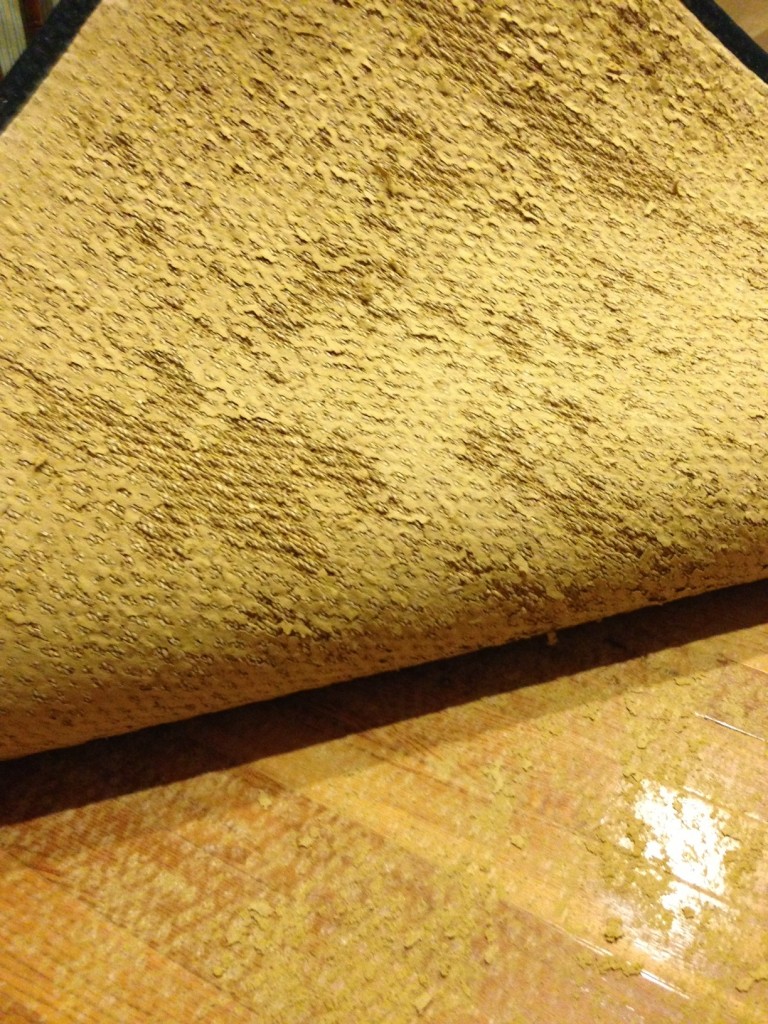
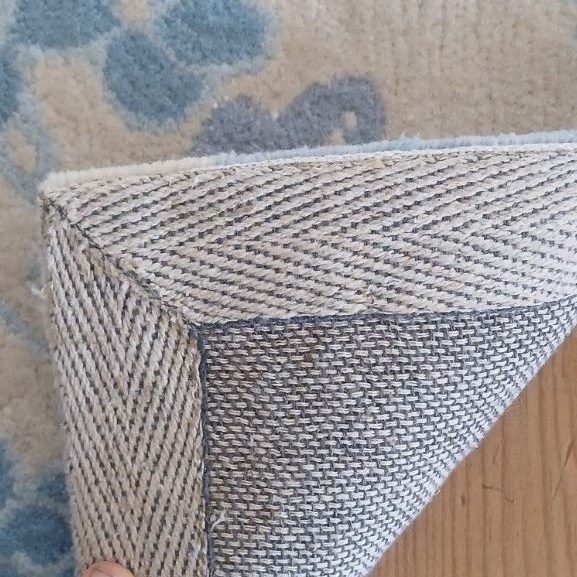
The latex layer on a hand-tufted rug – once this degrades, the rug cannot be repaired
A Vancouver boutique retailer’s repeat-customer problem
A home furnishings boutique in Vancouver’s Kitsilano neighborhood started stocking hand-tufted rugs from a South Asian wholesaler in 2018. By 2022, they were getting calls from customers whose rugs were shedding what looked like fine sand under the backing. The latex was degrading. Replacement requests came in. The boutique replaced several rugs under goodwill, about CAD $8,000 out of pocket. When they reached out to us, the first thing they asked was: “How do we make sure we never have that conversation again?”
The answer is construction. Hand-knotted rugs don’t have latex. There is no backing to degrade. The conversation never happens.
Hand knotted vs hand tufted rugs: Two terms that mean very different things
Walk the floor of any mid-to-high-end home furnishings trade show in Toronto or Vancouver and you’ll see both terms on spec sheets: “hand-knotted” and “hand-tufted.” They are often treated as equivalent. They are not.
Hand-knotted:
Every knot tied by a human hand, directly onto the warp threads of a vertical loom
A Nepali piece contains anywhere from 60 to 300 knots per sq.in.
Zero adhesive. No secondary backing. Production time: 3 to 6 months
Lifespan: 25 to 30 years under NP Rugs’ conservative specifications; well-maintained antique Nepali pieces remain in active use after 80+ years
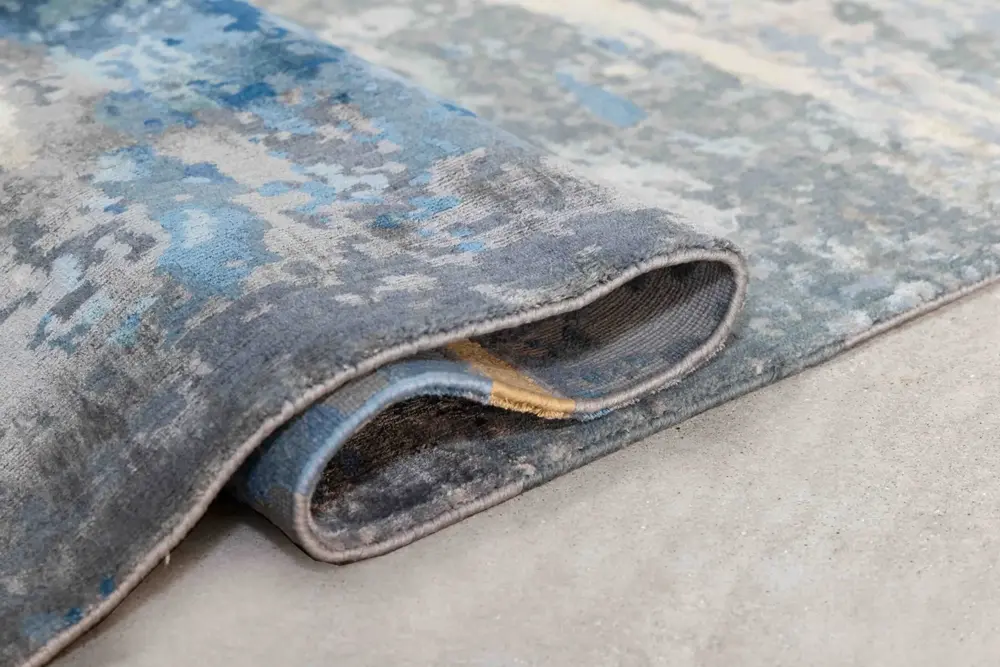
Knotted reverse: every knot tied by hand, no adhesive, no backing
Hand-tufted:
Tufted reverse: cloth panel covers the latex adhesive layer underneath
A design is stenciled onto canvas; a worker uses a tufting gun to push yarn through
Reverse coated in latex adhesive; cloth backing applied to cover it
Production time: 1 to 3 weeks
Lifespan: 10 to 15 years at NP Rugs’ quality standard (above market average)
Both involve human labor. Only one results in a product built to outlast the person who buys it.
What most buyers get wrong about “handmade” – and what it costs in Canada
The problem is that “handmade” in Canadian retail marketing covers both construction types. A buyer stocking hand-tufted rugs as “handmade artisan pieces” is not technically wrong. They are handmade. But when an end customer in Montreal spends CAD $1,800 on a rug based on that description and the backing starts crumbling in year eight, they are not going to buy from that retailer again. And they are going to tell people.
The second mistake is underestimating what Canadian conditions do to latex. Latex is sensitive to temperature variation and humidity. Canadian homes – basements, entryways, cottages, ski chalets – create environments where the degradation cycle accelerates compared to a controlled US apartment. The 7 to 10 year timeline for latex failure can shorten to 4 to 6 years in a Muskoka cottage or a Montreal basement that swings between -15°C winters and humid summers.
Hand-knotted rugs have no latex. No backing to peel. No moisture-sensitive adhesive layer. In a Canadian winter home, that’s not a premium feature. It’s a practical one.
The cold-climate case for Himalayan wool
Canadian buyers understand wool. The cold-climate case for hand-knotted rugs goes deeper than construction.
Himalayan wool – the primary material in Nepali hand-knotted rugs – comes from sheep living at altitude with serious temperature variation. The fiber is naturally dense, resilient, and lanolin-rich. It handles cold, moisture, and heavy use differently than lower-altitude wool.
Hand-tufted rugs also use wool in many cases. But when Himalayan wool is paired with hand-knotted construction – no adhesive, no canvas backing – you get a rug that performs as functional insulation, not just floor decoration. In a Toronto living room that gets to -20°C drafts under the door in January, that distinction matters.
What the lifespan numbers mean for Canadian wholesale
Hand-tufted (NP Rugs)
Hand-knotted (NP Rugs)
Construction
Tufting gun + latex adhesive
Hand-tied knots, no adhesive
Production time
1–3 weeks
3–6 months
Wholesale price (8×10 ft)
CAD $1,000–$1,300
CAD $2,000–$2,600
Lifespan
10–15 years
25–30 years (conservative)
Resale value
None
Retains and appreciates
Reversible
No
Yes
High-traffic suitability
Limited
Yes
GoodWeave certified
Yes
Yes
End-client replacement cycle
Every 7–12 years
25+ years
For boutique home stores in Vancouver or Toronto, a client spending CAD $1,200–$2,000 on a rug is not looking for a trend piece. They want something they can tell a story about. A hand-knotted rug from Nepal — GoodWeave certified, Himalayan wool, women-led artisan workshop, 35 years of manufacturing history — is a retail conversation, not a spec sheet.
One knotted rug over 25 years, versus two or three tufted replacements. The math is not close.
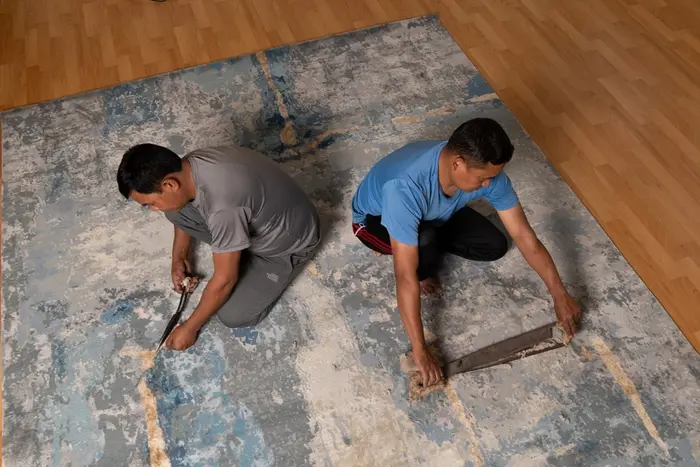
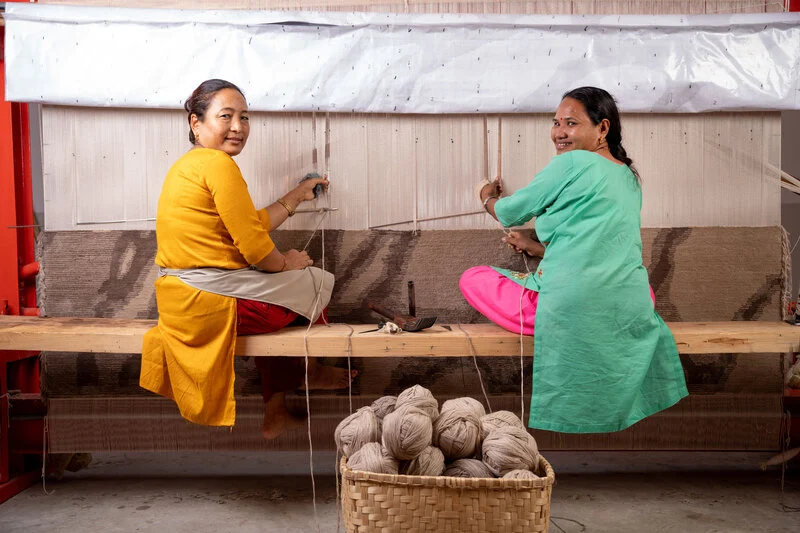
Master weavers at NP Rugs’ Kathmandu workshop – each knot tied individually on a vertical loom
How to identify construction before you buy
Smell it. A new hand-tufted rug sometimes has a faint latex or rubber smell in a warm room. Knotted rugs do not.
Flip the rug. Knotted: pattern mirrored on reverse, individual knots visible, no backing material. Tufted: canvas panel covering the latex layer.
Check the fringe. Knotted: structural, the natural continuation of warp threads. Tufted: attached afterward as decoration.
The ethical sourcing conversation Canadian retailers are having
Canadian consumers in Toronto, Vancouver, and Montreal are asking about production conditions before purchase. It’s not a fringe behaviour – it’s a mainstream expectation in the boutique premium segment.
GoodWeave certification means the rug was produced without child labor, in a certified factory with open-door independent inspection. Since 1995, GoodWeave has helped reduce child labor in Nepal’s carpet industry by approximately 75%.
Label STEP covers fair wages, safe conditions, and community welfare. NP Rugs holds both.
When your retail clients are asked “where was this made and by whom?” – the answer with NP Rugs product is specific: Kathmandu and Sarlahi, Nepal; GoodWeave and Label STEP certified; women-led artisan village; manufacturing since 1991. That’s a retail story. Not a compliance box.
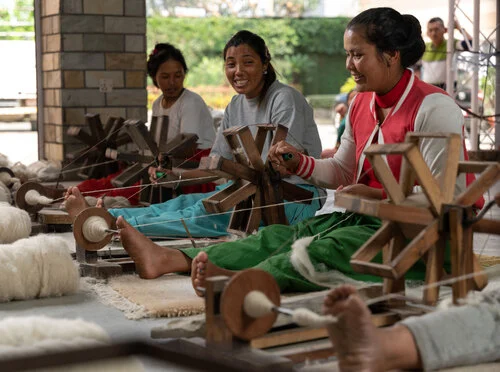
Artisans at NP Rugs’ Sarlahi workshop – 100+ women-led, GoodWeave and Label STEP certified. Certificate numbers available on request to wholesale buyers.
Why Nepal and why NP Rugs for Canada
Nepal benefits from Canadian GSP tariff exemptions – which directly affects your landed cost compared to China- or India-sourced alternatives. According to the Nepal Carpet Manufacturers and Exporters Association (NCMEA), Nepal’s handmade rug sector represents a significant share of the country’s total export earnings, with Germany and North America as leading markets.
NP Rugs has been manufacturing from Kathmandu since 1991 – 35 years with the same Tibetan double-knot construction and Himalayan materials. We export directly to Canada, MOQ from 20 pieces.
Our wholesale rugs for Canada catalogue covers both hand-knotted and hand-tufted lines with Canadian pricing. If you’re building a private label collection, our custom rugs programme accepts briefs from first sample through full production run.
FAQ
Does latex degradation happen faster in Canadian climates?
Yes. Latex is sensitive to temperature cycling and humidity. Environments with cold winters and humid summers – basements, entryways, cottages – accelerate the process compared to stable apartment conditions.
What is NP Rugs’ MOQ for Canada?
No minimum. We accept single custom orders as well as full wholesale runs. Sampling available before any commitment.
Can Canadian buyers get custom designs?
Yes. Our custom programme works with your design brief from concept through production. Typical lead time for a custom hand-knotted run is 8 to 12 weeks.
Is GoodWeave certification required to import rugs into Canada?
Not legally required, but increasingly required by Canadian boutique retailers and their corporate social responsibility policies. NP Rugs holds current GoodWeave certification for all certified lines.
NP Rugs ist ein GoodWeave- und Label STEP-zertifizierter Hersteller aus Kathmandu, Nepal. Seit 1991 exportieren wir handgefertigte Teppiche nach Deutschland und in über 60 weitere Länder. Großhandelsanfragen: nprugs.com/contact
A note from NP Rugs leadership
“Canadian buyers ask about the artisans. Not as a formality – they genuinely want to know who made the rug and whether that person was treated fairly. When I was leading the Nepal Carpet Manufacturers & Exporters Association, that question was the entire agenda. We weren’t just building an export industry. We were building one that the artisans themselves could be proud of. NP Rugs’ Sarlahi workshop is the answer I give when someone asks if we took that seriously.”
Tenzing Sherpa , Chairman & Founder, NP Rugs | Former President, Nepal Carpet Manufacturers & Exporters Association (NCMEA)
“Every Canadian order we fulfill goes through the same quality process as our largest European accounts. There is no minimum below which our standard drops. A 20-piece order for a boutique in Vancouver gets the same loom oversight and certification documentation as a 500-piece container. That is not a policy we wrote recently – it is how this company has always worked.”
To provide the best experiences, we use technologies like cookies to store and/or access device information. Consenting to these technologies will allow us to process data such as browsing behavior or unique IDs on this site. Not consenting or withdrawing consent, may adversely affect certain features and functions.
Functional
Always active
The technical storage or access is strictly necessary for the legitimate purpose of enabling the use of a specific service explicitly requested by the subscriber or user, or for the sole purpose of carrying out the transmission of a communication over an electronic communications network.
Preferences
The technical storage or access is necessary for the legitimate purpose of storing preferences that are not requested by the subscriber or user.
Statistics
The technical storage or access that is used exclusively for statistical purposes.The technical storage or access that is used exclusively for anonymous statistical purposes. Without a subpoena, voluntary compliance on the part of your Internet Service Provider, or additional records from a third party, information stored or retrieved for this purpose alone cannot usually be used to identify you.
Marketing
The technical storage or access is required to create user profiles to send advertising, or to track the user on a website or across several websites for similar marketing purposes.