Understanding the difference between hand knotted vs hand tufted rugs is the most important decision a wholesale buyer makes – and the most commonly misunderstood one.
TL;DR
A hand-knotted rug (handgeknüpfter Teppich) is constructed entirely on a vertical loom – 150,000 to 250,000 individual knots per 200×300 cm piece, no adhesive, lifespan of 25 to 100 years. A hand-tufted rug (handgetufteter Teppich) uses a mechanical tufting gun and latex backing – lifespan of 10–15 years at premium quality, non-repairable once the latex degrades. Germany absorbs over 45% of Nepal’s total carpet exports, according to Nepal’s Carpet and Textile Office (NCMEA). NP Rugs holds GoodWeave and Label STEP certifications – both required by German retailers and EU Green Claims Directive compliance frameworks. Wholesale pricing: €600–€800 (tufted, 200×300 cm) vs. €1,200-€1,600 (knotted, same size). Nepal benefits from EU GSP tariff exemptions affecting landed cost directly.
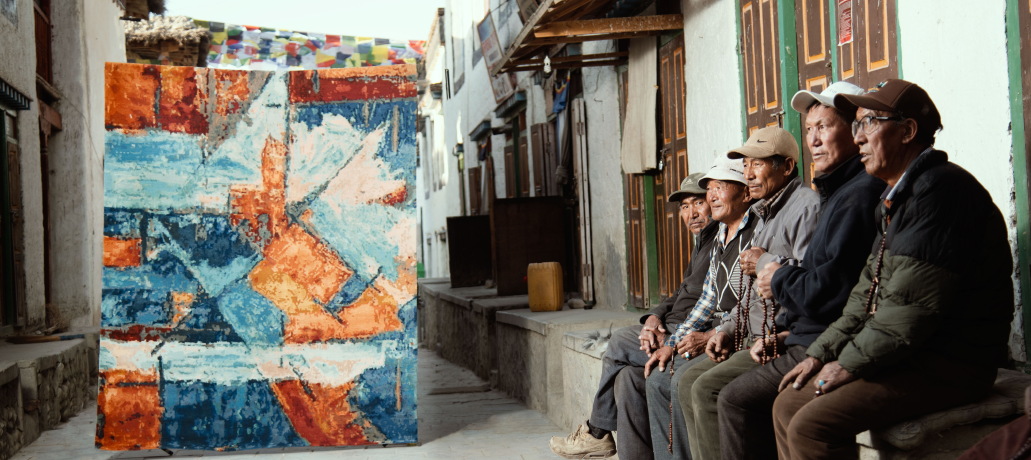
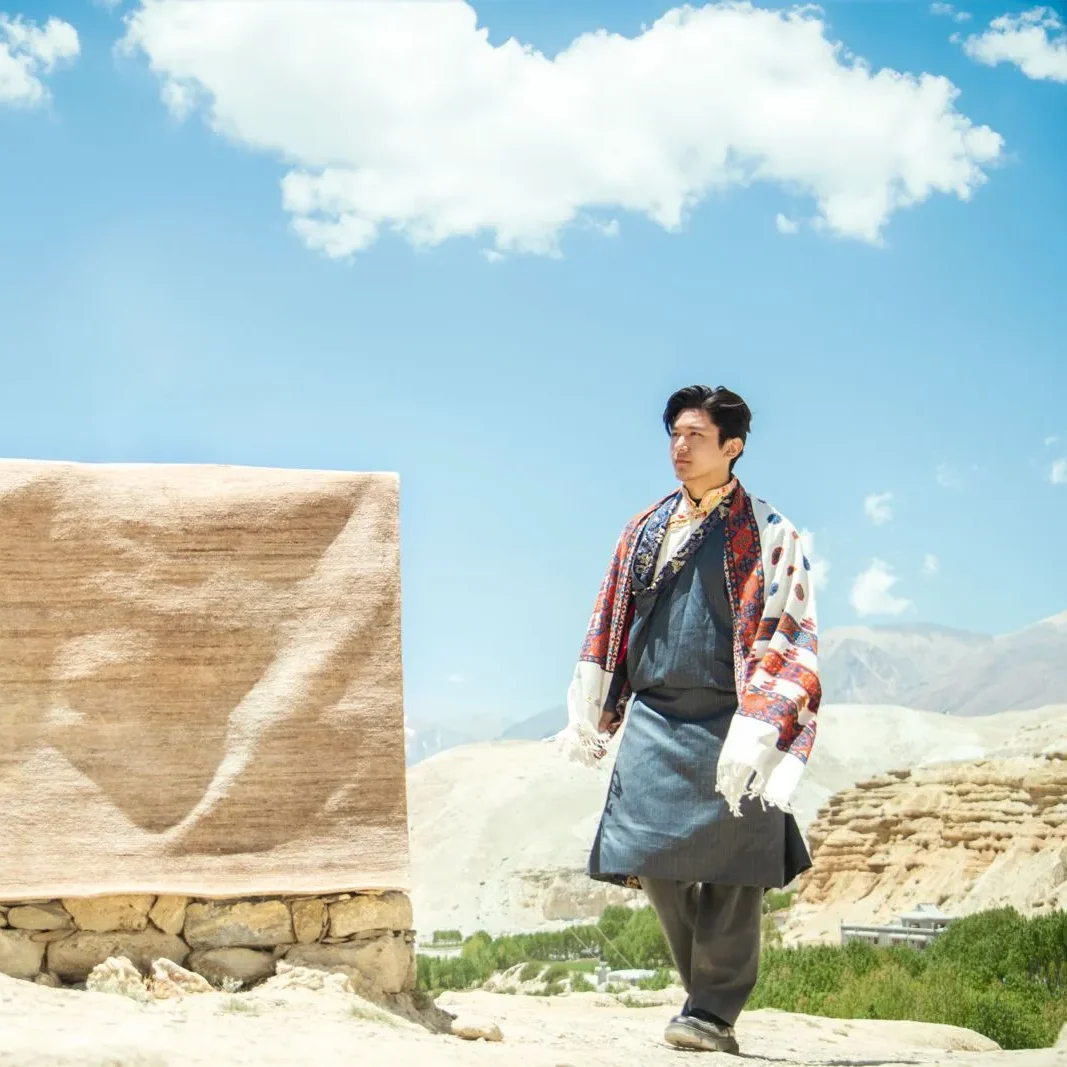
A hand-knotted Tibetan-knot rug from NP Rugs’ Kathmandu workshop
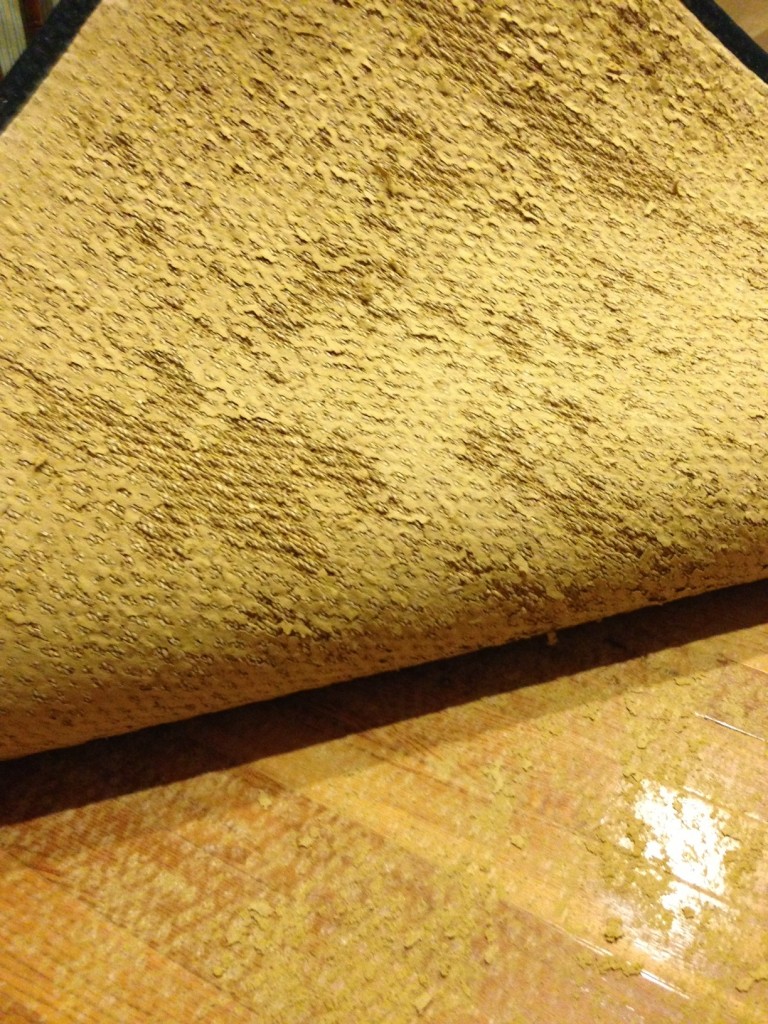
The latex layer on a hand-tufted rug – once this degrades, the rug cannot be repaired
The Hamburg importer who asked the right question
A furniture retailer in Hamburg contacted us in 2022 asking a question we don’t hear often enough: “If I put your hand-tufted rug in our catalogue next to your hand-knotted rug, and a customer asks me what the difference is – what do I tell them?” That question is the right one. Most buyers ask about price. Some ask about lead time. Very few ask the question that actually determines whether their retail clients come back in five years with a complaint or come back in ten years to reorder.
The honest answer: the difference is structural. One will outlast your customer. One will need to be replaced before they move house. Which one you stock determines the kind of business relationship you have.
Hand knotted vs hand tufted rugs: The construction difference, stated plainly
Hand-knotted (handgeknüpft):
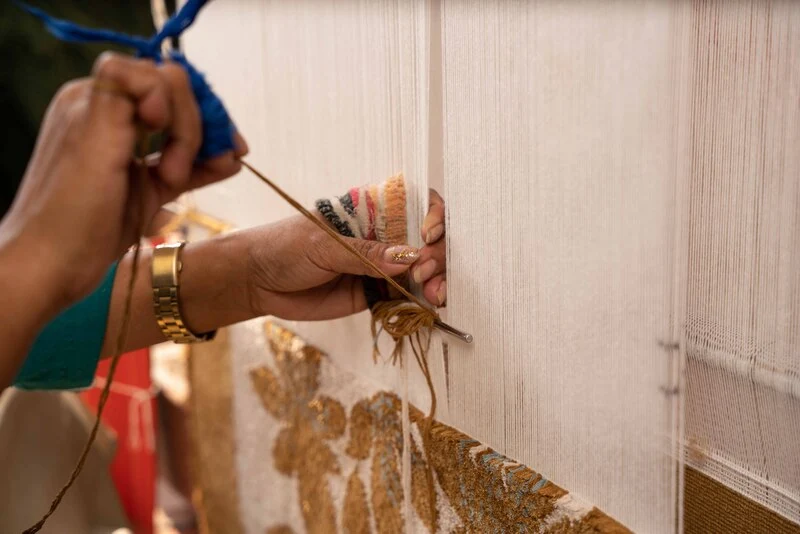
A master weaver ties each knot individually around the warp and weft threads of a vertical loom, by hand, one at a time
A piece contains anywhere from 60 to 300 knots per sq.in.
No adhesive. No secondary backing. The rug’s structure is entirely the knot-work
Production time: 3 to 6 months
Lifespan: 25 to 30 years under NP Rugs’ conservative specs; independent sources cite 80 to 200 years for antique-quality pieces
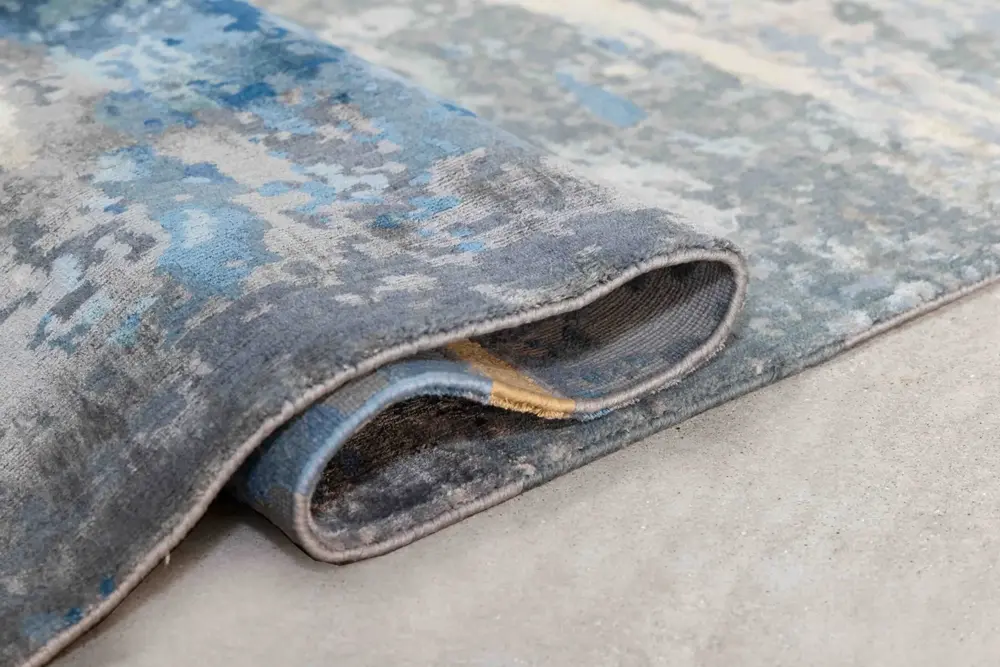
Knotted reverse: every knot tied by hand, no adhesive, no backing
Hand-tufted (handgetuftet):
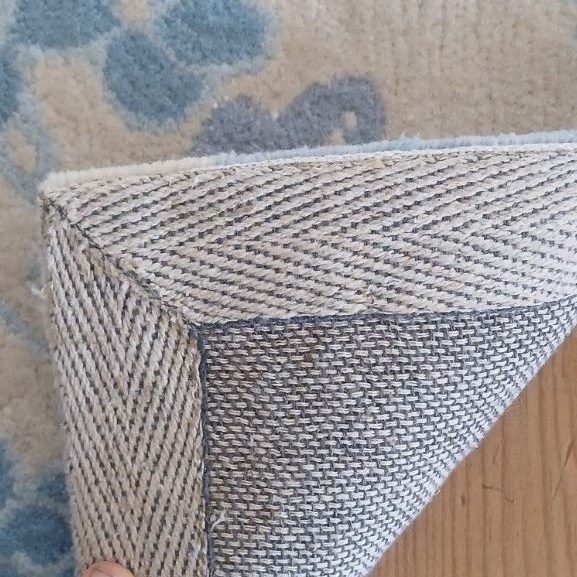
Tufted reverse: cloth panel covers the latex adhesive layer underneath
A design is stenciled onto a canvas frame; a worker uses a tufting gun to push yarn through the canvas
Latex adhesive is applied to the back; a cloth backing is pressed on to secure the pile
Production time: 1 to 3 weeks
Lifespan: 10 to 15 years at NP Rugs’ quality standard – above the market average, but subject to latex degradation regardless
From the front, at normal viewing distance, they can look nearly identical. Flip either one over. The difference is obvious.
What most buyers get wrong about “handmade” in the German market
The German market has a specific problem with this distinction: the word handgefertigt (handmade) is applied to both construction types in product marketing, and that is increasingly a legal exposure.
Under the EU Unfair Commercial Practices Directive and the forthcoming Green Claims Directive, vague environmental or craftsmanship claims face active scrutiny. Applying handgefertigt to a product that uses a mechanical tufting gun and synthetic latex adhesive is defensible in some contexts and not others. German consumer protection bodies have been active in this space. Retailers stocking hand-tufted product as “handmade” without disclosure of the construction method are carrying a compliance risk that was marginal five years ago and is not marginal now.
Hand-knotted construction has no such ambiguity. Every knot is tied by a human hand. There is no mechanical step. The EU Handmade Label applies. GoodWeave certifies the labor conditions. The product’s construction claim is completely defensible.
GoodWeave and what German retailers actually require
GoodWeave International certification is the global standard for child-labor-free handmade rug production. In the German retail context, it is not a differentiator – it is a baseline requirement. Major German furniture retailers and interior design distributors require GoodWeave certification documentation before listing handmade rug products.
OEKO-TEX Standard 100 is a parallel baseline expectation for textile imports into the German market.
NP Rugs holds both GoodWeave and Label STEP certification. Label STEP covers fair wages, safe working conditions, and community welfare across all ten World Fair Trade Organization standards. Both certificates are current, with verifiable certificate numbers.
Since 1995, GoodWeave has helped reduce child labor in Nepal’s carpet industry by approximately 75%. Germany was an early market to require this certification – and NP Rugs has been certified since well before it became a standard requirement.
The math for your end clients: $1,800 once, versus $900 three times over 25 years. And the $1,800 piece holds its value if they ever want to sell it. The $900 piece goes to landfill when the backing gives out.
How to identify construction before you place an order
The knot count: Quality Nepali knotted rugs carry 80 to 120 knots per square inch. Hand-tufted rugs have zero knots – the pile is held by adhesive.
The reverse test: Flip the rug. A hand-knotted piece shows the pattern mirrored on the reverse, with individual knots visible and no backing material at all. A hand-tufted piece has a cloth panel covering the latex layer.
The fringe test: On a knotted rug, fringe is structural – the natural continuation of the loom’s warp threads. On a tufted rug, fringe is glued or stitched on afterward as decoration.
Side-by-side: the numbers for German buyers
Hand-tufted (NP Rugs)
Hand-knotted (NP Rugs)
Construction
Tufting gun + latex adhesive
Hand-tied knots, no adhesive
Production time
1–3 weeks
3–6 months
Wholesale price (200×300 cm)
€600–€800
€1,200–€1,600
Lifespan
10–15 years
25–30 years (conservative)
Resale value
None
Retains and appreciates
Reversible
No
Yes
High-traffic suitability
Limited
Yes
GoodWeave certified
Yes
Yes
EU Handmade Label eligible
Limited
Yes
End-client replacement cycle
Every 7–12 years
25+ years
The 2x price differential buys 3x the lifespan and the only product that legitimately carries a provenance narrative, appreciates in value, and avoids the replacement conversation with end clients.
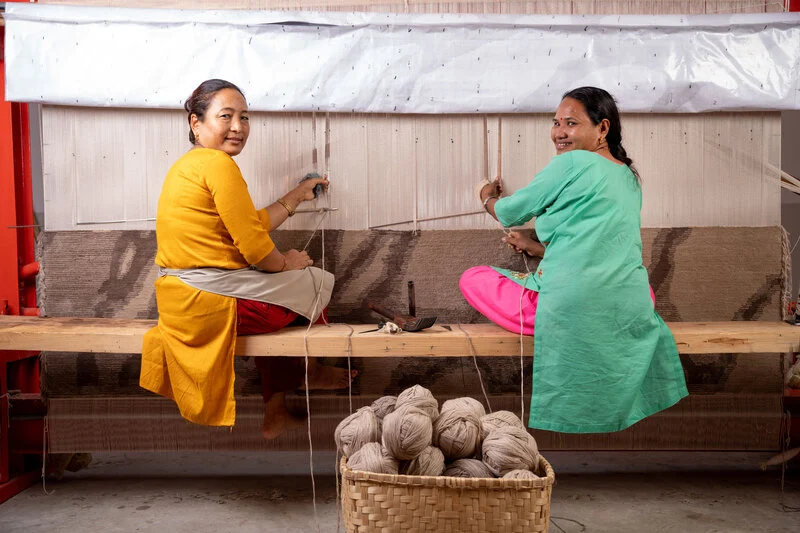
Master weavers at NP Rugs’ Kathmandu workshop – each knot tied individually on a vertical loom
Why Nepal is Germany’s largest rug source – and has been for decades
Germany absorbs more than 45% of Nepal’s total carpet exports, according to the Nepal Carpet Manufacturers and Exporters Association (NCMEA). That relationship exists because German importers understood early what most markets took longer to figure out: Tibetan double-knot construction, Himalayan wool, and a certified ethical supply chain are a combination that no other origin matches.
Nepal’s GSP tariff exemptions apply to EU imports, directly affecting the landed cost calculation for German buyers. NP Rugs ships direct from Kathmandu with MOQ from 20 pieces and experience with German customs documentation requirements.
Our full range is available via our wholesale rugs for Germany/DACH catalogue. For private label buyers building German or DACH retail collections, our custom rugs programme works with your design brief from the first sample.
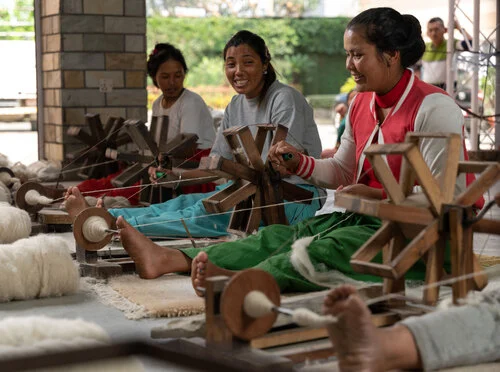
Artisans at NP Rugs’ Sarlahi workshop – 100+ women-led, GoodWeave and Label STEP certified. Certificate numbers available on request to wholesale buyers.
FAQ
Does NP Rugs provide GoodWeave certificate numbers for individual batches?
Yes. Every certified order comes with traceable certificate documentation. Your retail clients can verify independently.
What is the lead time for a hand-knotted wholesale order for Germany?
3 to 6 months production, plus shipping. We plan production calendars with buyers to fit retail buying cycles. Stock items ship faster.
Are NP Rugs products OEKO-TEX compliant?
Our materials and dyes meet OEKO-TEX Standard 100 requirements. Documentation available on request
What does the EU Green Claims Directive mean for German retailers stocking hand-tufted rugs?
Any claim of “handmade,” “sustainable,” or “eco-friendly” applied to a hand-tufted product needs to be accurate and substantiated under the Directive. NP Rugs provides full construction documentation to support accurate product claims.
NP Rugs ist ein GoodWeave- und Label STEP-zertifizierter Hersteller aus Kathmandu, Nepal. Seit 1991 exportieren wir handgefertigte Teppiche nach Deutschland und in über 60 weitere Länder. Großhandelsanfragen: nprugs.com/contact
A note from NP Rugs leadership
“Germany was the market that taught me what certification really means. When I was President of the Nepal Carpet Manufacturers & Exporters Association, we worked directly with German importers and GoodWeave to build the standards the industry now runs on. Germany didn’t just buy our rugs – it helped shape how Nepal’s entire carpet sector operates. That relationship is something I take seriously, and so does everyone at NP Rugs”
Tenzing Sherpa , Chairman & Founder, NP Rugs | Former President, Nepal Carpet Manufacturers & Exporters Association (NCMEA)
“The German market asks harder questions than almost any other. Questions about supply chain, about certification, about what happens at the loom level. I welcome those questions. If a German importer asks me to trace a specific batch back to the artisan who made it, we can do that. That traceability is not a compliance exercise – it is how we run the business.”
To provide the best experiences, we use technologies like cookies to store and/or access device information. Consenting to these technologies will allow us to process data such as browsing behavior or unique IDs on this site. Not consenting or withdrawing consent, may adversely affect certain features and functions.
Functional
Always active
The technical storage or access is strictly necessary for the legitimate purpose of enabling the use of a specific service explicitly requested by the subscriber or user, or for the sole purpose of carrying out the transmission of a communication over an electronic communications network.
Preferences
The technical storage or access is necessary for the legitimate purpose of storing preferences that are not requested by the subscriber or user.
Statistics
The technical storage or access that is used exclusively for statistical purposes.The technical storage or access that is used exclusively for anonymous statistical purposes. Without a subpoena, voluntary compliance on the part of your Internet Service Provider, or additional records from a third party, information stored or retrieved for this purpose alone cannot usually be used to identify you.
Marketing
The technical storage or access is required to create user profiles to send advertising, or to track the user on a website or across several websites for similar marketing purposes.