
Published: June 2026 | Reading time: 14 minutes | Written by: Np Rugs Export Team
Sourcing handmade rugs directly from a Nepal manufacturer saves the average trade buyer 20–35% compared to purchasing through a distributor – and gives you control over design, quality, and lead times that no middleman can offer.
This guide walks you through the complete process: from evaluating a manufacturer for the first time, through sampling, production, quality control, and export – based on more than 30 years of working with importers, interior designers, and distributors across the US, Europe, and Australia.
Whether you are placing your first international order or switching from an Indian or Turkish source, this is the reference guide you need before you begin.
Table of Contents
- Why Source Direct from a Nepal Manufacturer?
- What to Look for When Evaluating a Nepal Rug Manufacturer
- The Step-by-Step First-Order Process
- Common Mistakes First-Time Importers Make
- Real-World Timeline: What 4–6 Months of Production Actually Looks Like
- FAQ: MOQ, Payment Terms, Certifications, and Shipping
1. Why Source Direct from a Nepal Manufacturer?
Sourcing direct from a manufacturer – rather than through an intermediary distributor or trading company – gives trade buyers three structural advantages.
Cost Efficiency: The Factory-Direct Price Difference
When you buy through a distributor, you pay for their margin, their warehouse, and their logistics overhead. Working directly with a Nepal rug manufacturer removes every one of those layers. For most buyers, this translates to a 20–35% reduction in unit cost at equivalent quality levels.
The US imported over $3.5 billion in rugs in 2023 (US International Trade Commission). For a buyer placing annual orders of $100,000 or more, that margin difference is not trivial – it is the difference between a profitable product line and a marginal one.
Design Control and Customization
Distributors sell from catalogue stock. Manufacturers sell from capability. Working directly with NP Rugs means you can:
- Submit your own design (Pantone, RAL, digital reference, or mood board)
- Specify exact pile height, knot count, material blend, and finishing technique
- Adjust size, shape, and border treatment at no additional specification cost
- Develop exclusive designs that your competitors cannot source from any distributor
Lead Time Transparency
When you work through an intermediary, every delay gets absorbed and re-framed. Working directly with the production team means you see exactly where your order is in the queue, receive QC images at each production milestone, and get accurate shipping forecasts – not optimistic ones.
2. What to Look for When Evaluating a Nepal Rug Manufacturer
Not every manufacturer in Kathmandu offers the same standard of production, ethical compliance, or export capability. Here is what matters when you are qualifying a potential manufacturing partner.
Certifications: The Non-Negotiable Tier
For trade buyers supplying major retailers in the US, Europe, or Australia, certifications are no longer optional. They are a procurement requirement.
| Certification | What It Certifies | Relevance |
|---|---|---|
| GoodWeave | No child labour, no forced labour, safe working conditions, community reinvestment | Required by Target, Wayfair, major EU retailers |
| STEP (Sustainable Textile Production) | Ecological and social responsibility across the supply chain | Growing EU requirement – preferred by German, Dutch, and Scandinavian buyers |
| GOTS (for wool) | Organic textile standard – soil to shelf | Relevant for natural-dye and organic wool programmes |
| OEKO-TEX STANDARD 100 | No harmful substances in final product | Consumer safety standard – supports retail onboarding |
NP Rugs holds GoodWeave and Label STEP certifications, and is an active, prominent member of the Nepal Carpet Manufacturers and Exporters Association (NCMEA). In fact, our founder previously served as the President of the NCMEA, which represents our deep commitment to the highest quality, ethical standards, and industry leadership in Nepal. View our certification documentation.
Tip
Read also: What GoodWeave Certification Means for Your Retail Buyers
NP Rugs is fully certified by GoodWeave and STEP and NCMEA, ensuring ethical labor practices and ecological responsibility.
Before signing any agreement with a manufacturer, ask for current certificate copies with expiry dates and third-party auditor names. A legitimate manufacturer provides these on request without hesitation.
Factory Visit Availability
A manufacturer who restricts or discourages factory visits is a manufacturer with something to hide. NP Rugs operates from a production facility at 780 Tusal Marg, Boudha, Kathmandu – buyers are welcome to visit before or during an active order. For buyers who cannot travel, we offer a documented factory video tour and real-time video call walkthroughs of the production floor.
Production Capacity and Order Consistency
Ask prospective manufacturers directly:
- How many looms do you operate?
- How many artisans are on your production team?
- What is your monthly production capacity in square metres?
- How do you handle batch consistency on repeat orders?
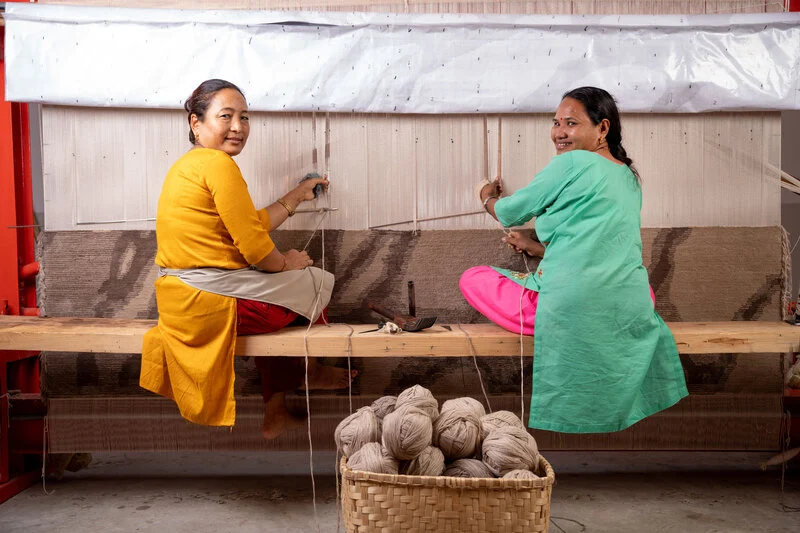
NP Rugs employs over 1,000 artisans and has operated continuously since 1991. Production consistency – matching dye lots, pile height, and knot density across batches – is a function of institutional knowledge that only comes with decades of manufacturing.
Export Experience and Documentation
Nepal’s exports of rugs to the US and EU involve a specific set of trade documentation. Your manufacturer must be able to supply:
- Commercial Invoice and Packing List
- Certificate of Origin (Nepal)
- GoodWeave Certificate (if required by your retailer)
- Phytosanitary Certificate (for natural wool and fibre products, when required)
- Bill of Lading (sea freight) or Airway Bill (air freight)
- HS Code classification (4 and 6 digit – rug HS codes are typically 5701–5705 depending on construction method)
An experienced manufacturer handles this documentation routinely. If your prospective manufacturer seems unfamiliar with US or EU import documentation requirements, treat it as a serious risk signal.
3. The Step-by-Step First-Order Process
Here is the complete process for placing a first order with NP Rugs, from initial enquiry through delivery at your warehouse.
Step 1: Initial Enquiry (Day 1–3)
Submit a sourcing enquiry through our trade contact page or via email to info@nprugs.com. Include:
- The type of rug you are looking for (hand-knotted, hand-woven, hand-loomed, hand-tufted,)
- Approximate size and quantity
- Any design references (photos, mood board, or Pantone codes)
- Your target price range per square metre
- Your timeline requirement
We respond to every trade enquiry within 48 business hours with a preliminary scope of work and a call invitation.
Step 2: Design and Specification Alignment (Week 1–2)
Once we understand your requirements, our design team prepares a technical specification sheet covering:
- Construction method (hand-knotted Tibetan knot, hand-tufted with backing, hand-loomed flat weave, or hand-woven flat weave/kilim)
- Material blend (Himalayan wool, New Zealand wool, silk, nettle fibre, or blended)
- Knot density (for hand-knotted rugs: typically 40–100 KPSI depending on design complexity)
- Pile height (ranging from 5mm for low-profile commercial to 20mm+ for luxury residential)
- Dye method (vegetable natural dye or AATCC-tested chromatic dye)
- Size and shape (including irregular shapes – L-shapes, rounds, runners)
- Colour specification (Pantone matching or RAL reference)
You review and approve the specification before we proceed to sampling.
Step 3: Sample Production (Week 3–8)
A physical sample – typically 30cm × 30cm for hand-knotted or a strike-off panel for hand-tufted – is produced in your specified colours and construction. Sampling takes 2–4 weeks from specification approval.
Samples are shipped to you via DHL or FedEx express courier (typically 3–5 business days from Kathmandu). Sample shipping costs are charged at cost price.
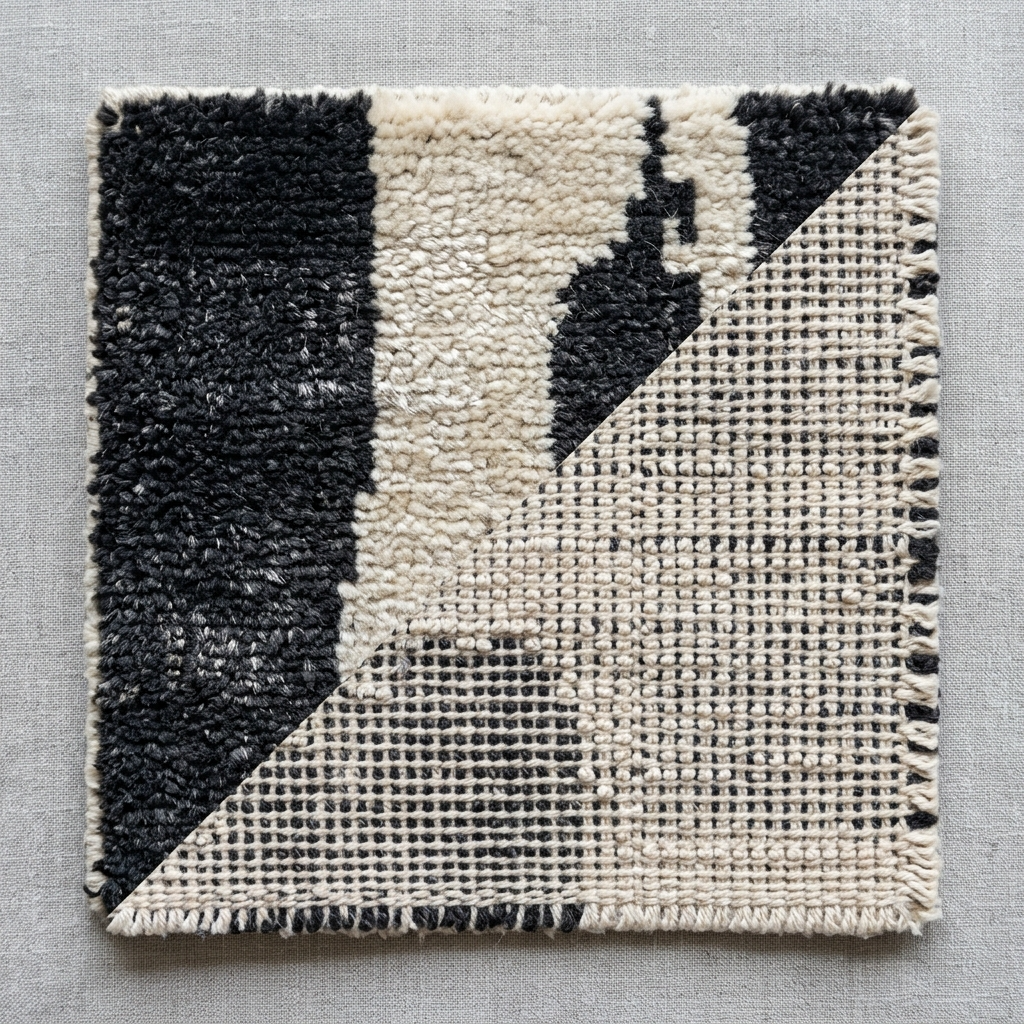
What to check when your sample arrives:
- Colour accuracy: Compare against your Pantone/RAL reference under standard daylight (D65 lighting)
- Handle and drape: Feel the pile density and evaluate if the stiffness is appropriate for your use case
- Pile height consistency: Run your hand across the pile in multiple directions – it should be even with no pulled or sunken areas
- Knot density uniformity: Flip the rug and examine the back. The knot grid should be even and tight
- Fringe or edge finishing: Check that the ends are properly secured and that the finishing matches the specification
Revisions can be requested before bulk production begins. Most buyers approve samples within 1–2 revision cycles.
Step 4: Order Confirmation and Production Start (Week 8–10)
Once the sample is approved:
- A Proforma Invoice is issued with the confirmed unit price, quantity, delivery terms (FOB Kathmandu or CIF destination port), and payment terms
- A deposit (typically 30–50% of order value) is paid to initiate production
- A Production Confirmation is sent to you with your assigned production team and estimated completion date
- Your order enters the production queue
Step 5: Production (Weeks 10–26)
Hand-knotted rugs require time that cannot be compressed without compromising quality. The production timeline depends on construction type:
| Construction | Typical Production Time |
|---|---|
| Hand-knotted (80 KPSI, 9×12 ft) | 14–20 weeks |
| Hand-knotted (40 KPSI, 9×12 ft) | 8–12 weeks |
| Hand-tufted (any size) | 4–6 weeks |
| Hand-loomed flat weave | 3–5 weeks |
| Hand-woven flat weave / Kilim | 4–6 weeks |
During production, NP Rugs provides progress updates at key milestones: warp setup, pile weaving at 25%, pile at 75%, washing, and finishing. You can request photographic documentation at any milestone.
Step 6: Quality Control Inspection (Week 26–28)
Before shipping, every order undergoes a structured QC inspection. Our standard process includes:
- Visual inspection under controlled lighting for pile consistency, dye uniformity, and pattern accuracy
- Dimensional check – each rug is measured and compared against the specified dimensions (±3% tolerance)
- Weight per square metre check – verifies material density is as specified
- Fringe and edge inspection – securing integrity and finishing consistency
- Photography – a complete photographic record is provided to you before shipping authorisation
Third-party pre-shipment inspection by SGS or Bureau Veritas is available on request. This is recommended for first orders above $20,000.
Step 7: Export and Shipping (Week 28–30)
After QC clearance, your order is packed, documented, and handed to your freight forwarder or shipped via NP Rugs’ logistics partners. We work with most major forwarders and can coordinate door-to-port or full door-to-door delivery.
Shipping time estimates (sea freight):
- Kathmandu to Kolkata port: 5–7 days overland
- Kolkata to Los Angeles: 22–28 days
- Kolkata to Rotterdam: 18–24 days
- Kolkata to Sydney: 20–25 days
Air freight is available for urgent orders or sample shipments. Transit time: 3–5 days from Kathmandu to most major destinations.
Step 8: Customs Clearance and Delivery
Your freight forwarder handles import customs clearance at the destination port. NP Rugs provides all required documentation. Nepal-origin rugs benefit from:
- US GSP (Generalised System of Preferences) – duty-free or reduced-duty access on many rug categories (verify current status with your customs broker, as GSP provisions are periodically reviewed by Congress)
- EU GSP+ – enhanced preferences for certified sustainable manufacturers, available because NP Rugs holds STEP certification
Your customs broker will classify your shipment under the correct HS code and handle duty payment. Once cleared, your rugs are delivered to your nominated warehouse.
4. Common Mistakes First-Time Importers Make
These are the most frequent errors we see from buyers placing their first Nepal rug order – and how to avoid them.
Mistake 1: Approving a Sample Under Artificial Lighting
Rugs photographed or reviewed under warm indoor lighting look fundamentally different from the same rug viewed under natural daylight or retail store lighting. Always evaluate your sample under D65 standard daylight conditions. If this is not possible, evaluate it outdoors on an overcast day. Colour approvals made under warm artificial light regularly result in complaints that the rug looks different in the store.
Mistake 2: Underestimating Lead Times
First-time importers frequently request hand-knotted rugs with 8-week delivery expectations. Hand-knotted rugs at any quality level require a minimum of 8–14 weeks for production alone – before shipping. For buyers with seasonal inventory requirements (spring launches, Christmas ranges), this means placing orders 6-8 months before your target in-store date, not 3 months.
Rule of thumb: Take your target delivery date. Subtract 30 days for shipping. Subtract the production time. That is your latest design approval date. Work backwards from there.
Mistake 3: Paying High Sample Fees Before Establishing a Relationship
Some manufacturers charge substantial sample fees before any conversation about the buyer’s actual requirements. NP Rugs charges for sample materials and production at cost – not as a profit centre. A manufacturer who quotes unusually high sample fees before understanding your project is treating you as a one-time transaction, not a long-term trade partner.
Mistake 4: Not Specifying the End Use
Residential rugs and contract/commercial rugs require different construction specifications. A rug that performs beautifully in a living room may wear prematurely in a hotel corridor with 200 footfalls per day. If your end use is hospitality, retail display, or any high-traffic setting, specify this clearly at briefing stage so your manufacturer can recommend the appropriate construction method, pile height, and fibre type.
Mistake 5: Assuming All Nepal Manufacturers Are the Same
Nepal’s rug industry includes manufacturers ranging from cottage workshops employing 5 artisans to large factory operations with 500+. Quality standards, ethical practices, export experience, and production consistency vary significantly. Always verify GoodWeave certification, request references from existing trade buyers, and ask to speak directly with the export team before committing.
Tip
Read also: Nepal vs India vs Turkey: Sourcing Handmade Rugs in 2025
5. Real-World Timeline: What 4–6 Months of Production Actually Looks Like
Here is a realistic calendar view for a first hand-knotted rug order, using a 9×12 ft rug at 80 KPSI as an example:
| Week | Activity |
|---|---|
| Week 1 | Initial enquiry submitted; responded to within 48 hours |
| Week 1–2 | Design and specification alignment calls; technical spec sheet approved |
| Week 3 | Sample production begins |
| Week 7 | Sample completed; shipped via DHL express |
| Week 8 | Sample received; buyer review begins |
| Week 9 | Sample approved (or revision requested) |
| Week 10 | Proforma Invoice issued; deposit payment received; order confirmed |
| Week 11 | Production begins – warp setup |
| Week 16 | 25% production milestone – photos sent to buyer |
| Week 21 | 75% production milestone – photos sent to buyer |
| Week 25 | Weaving complete; washing and finishing begins |
| Week 27 | QC inspection – report and photos sent to buyer |
| Week 28 | Shipping authorisation; handover to freight forwarder |
| Week 29 | Departure from Kolkata port (sea freight) |
| Week 33–35 | Arrival at destination port |
| Week 34–36 | Customs clearance and delivery to warehouse |
Total elapsed time from first enquiry to warehouse arrival: approximately 34–36 weeks.
For buyers who already have an approved design on file and have previously placed a sample order, subsequent orders move significantly faster – production can begin within 2 weeks of order confirmation.
6. FAQ: MOQ, Payment Terms, Certifications, and Shipping
What is the minimum order quantity (MOQ) for NP Rugs?
NP Rugs has no minimum order quantity (MOQ). We accommodate custom orders starting from just a single piece (1 piece MOQ) for bespoke residential or hospitality projects, as well as bulk commercial orders of 500+ pieces. We believe trade buyers and designers should have complete flexibility to source exactly what they need.
What payment terms does NP Rugs offer?
Standard payment terms for first-time buyers are 30–50% deposit on order confirmation, with the balance due on presentation of shipping documents (Bill of Lading or Airway Bill). We accept international bank transfer (T/T), Letter of Credit (L/C) for large orders, and select escrow arrangements for new buyer relationships. Buyers with an established order history may qualify for extended payment terms.
What certifications does NP Rugs hold?
NP Rugs holds current GoodWeave and Label STEP certifications. Additionally, NP Rugs is a leading, active member of the Nepal Carpet Manufacturers and Exporters Association (NCMEA), and our founder previously served as the President of the NCMEA. This solidifies our authority, quality standards, and industry leadership inside Nepal. Copies of our certifications are provided with every commercial shipment for retail compliance and ESG reporting.
Can I visit the NP Rugs factory in Kathmandu?
Yes. Trade buyers are welcome to visit our production facility at 780 Tusal Marg, Boudha, Kathmandu. We accommodate pre-order visits, mid-production audits, and end-of-production QC inspections. Contact us at least 2 weeks in advance to schedule. For buyers who cannot travel, a live video tour of the production floor can be arranged.
How is shipping handled, and what are the Incoterms options?
We can ship on FOB Kathmandu (buyer arranges freight from Nepal), CFR (we arrange freight to destination port), or CIF (we arrange freight and insurance to destination port). We work with experienced freight forwarders familiar with Nepal-origin textile shipments and can recommend partners if you do not have an established forwarder relationship.
How does NP Rugs handle quality failures or damaged goods on arrival?
All shipments are photographically documented pre-departure. In the event of damage in transit, the photographic record establishes the condition at the point of handover and supports insurance claims. Manufacturing defects identified within 30 days of delivery are replaced at no charge. We recommend buyers inspect and document their consignment within 14 days of warehouse receipt.
Does NP Rugs offer private label or white label programmes?
Yes. Trade buyers can supply their own branding for labels, care instructions, hang tags, and packaging materials. We integrate buyer branding into the production and packaging process at no additional cost. This is especially relevant for retailers developing their own branded rug range.
What rug constructions does NP Rugs manufacture?
NP Rugs specializes in four primary handmade constructions:
- Hand-knotted – the highest quality and most durable construction; each knot is individually tied by hand using the traditional Tibetan knot technique, suited for custom pile heights and intricate designs.
- Hand-woven – flat-weave construction (such as kilims and flat weaves) woven without a pile; lightweight, durable, reversible, and ideal for contemporary layering.
- Hand-loomed – woven on traditional hand looms to create elegant flat or low-pile textures; ideal for clean, modern, and transitional interiors.
- Hand-tufted – pile loops or cut pile inserted into a stretched canvas backing using a manual tufting gun, then secured with a secondary backing; offers faster production times for volume orders.
Ready to Start Your First Order?
NP Rugs has been manufacturing and exporting handmade rugs from Kathmandu since 1991. Our export team works directly with importers, interior designers, hospitality buyers, and distributors across the US, Europe, and Australia.
Three ways to begin:
- Request a trade sample — Submit a design reference and we will produce a physical sample at cost price
- Start a custom rug brief — Tell us your design, size, construction, and quantity requirements
- Speak with our export team – Call +977-9765960464 (Nepal) or whatsapp or email info@nprugs.com
About the Author
This guide was prepared by the NP Rugs export and trade team – a team with combined 60+ years of experience in handmade rug production, international trade, and buyer relations. NP Rugs has manufactured and exported rugs to buyers in 30+ countries since 1991.
Last updated: June 2026