
Published: July 2026 | Reading time: 12 minutes | Written by: NP Rugs Team
Every importer who reaches out to us eventually asks the same question.
“We’re talking to suppliers in Nepal, India, and Turkey. Help us understand the real difference.”
It is the right question. And because we are a Nepal-based manufacturer with three decades of experience watching importers make sourcing decisions that delight or destroy their margins, we are going to give you an honest answer – including where India and Turkey legitimately beat us.
This guide covers the four major origin countries for premium handmade rugs (Nepal, India, Turkey, and Iran – with Iran addressed briefly due to its current trade complications) through the lens of a US importer or European distributor looking to build or optimise a wholesale product line in 2026.
The Big Picture: Understanding the Global Handmade Rug Market in 2026
The global handmade rug market is not monolithic. It is a spectrum of quality, technique, material, and price that ranges from a $150 hand-tufted rug made in a month to a $25,000 hand-knotted masterpiece that took two artisans eighteen months.
The three primary origins – Nepal, India, and Turkey – occupy distinct positions on that spectrum. Confusing them is the single most expensive mistake a new importer makes.
| Factor | Nepal | India | Turkey |
|---|---|---|---|
| Primary Technique | Tibetan loop-knot (hand-knotted) + hand-tufted in same product line | Persian/Turkish knot (hand-knotted), hand-tufted, flatweave | Hand-knotted (Persian/Turkish knot), kilim, flatweave |
| Knot Type | Tibetan loop knot – gauge-rod construction, unique to Nepal/Tibet | Persian (asymmetric) or Turkish (symmetric) – Mughal tradition | Persian (asymmetric) or Turkish (symmetric) |
| Knot Density Range | 60–150 KPSI | 40–120 KPSI | 40–100 KPSI |
| Price Range (FOB) per sq ft | $35–$120+ | $12–$65 | $20–$80 |
| Primary Material | Himalayan wool, Tibetan wool, silk | Indian wool, NZ wool, viscose, silk | Turkish wool, cotton, silk |
| Production Model | Centralised — weaving, dyeing, finishing on one campus | Fragmented — looms in Rajasthan villages; dyeing often in Haryana/Panipat | Mostly centralised workshops |
| Production Capacity | 5,000+ sqm/month (established manufacturers) | Highly variable — small workshops to large factories | Moderate (100–2,000 sqm/month typical) |
| Lead Time (custom) | 18–22 weeks | 12–18 weeks | 10–18 weeks |
| MOQ (custom) | 1 unit (lobby) / 20 units (room rollout) | 20–50 units | 10–30 units |
| GoodWeave / Ethical Cert | Strong (Nepal is GoodWeave’s founding origin) | Available but inconsistent across suppliers | Limited formal certification |
| COO Duty Advantage (EU) | GSP Everything But Arms (lowest tariff bracket) | GSP Standard | Customs Union (duty-free) |
| COO Duty (US, 2026) | GSP (suspended, historically 0%) | ~3.8–4.4% | ~3.5% |
| Customisation Depth | Extremely high – infinite colour, format, design, construction type | High – large supplier ecosystem | Moderate – stronger in traditional aesthetics |
| Quality Consistency | Very high – centralised production eliminates batch variation | Variable – fragmented supply chain creates dye-lot and specification risks | High for mid-tier, variable at lower price points |
Nepal: The Premium Artisan Origin
Why Nepal Produces the World’s Best Hand-Knotted Rugs
Nepal’s rug industry developed specifically around the Tibetan weave – a technique brought by Tibetan refugees in the 1960s. This was not a folk tradition repurposed for export. It was, from its inception, a precision craft tradition designed for international markets.
The result is a cluster of highly skilled artisans, specialised infrastructure, and a sourcing chain built around one material above all others: Himalayan and Tibetan highland wool.
This wool is categorically different from the wool used in most other rug-producing countries. Grown at altitude in extreme cold, Himalayan wool has a longer staple length, a natural lanolin content that resists soiling, and a resilience under compression that is measurably superior to lowland alternatives. When a hospitality buyer specifies “crush resistance” for a hotel lobby rug, they are specifying Himalayan wool without always knowing it.
Nepal’s Specific Advantages for Importers
1. A Fundamentally Different Knotting Technique
This is the point most sourcing comparisons miss entirely. Nepal and India are not producing the same product by different hands – they are using structurally different knotting techniques.
Nepal uses the Tibetan loop knot (also called the Senna loop). Rather than tying individual knots, Nepalese artisans loop continuous yarn around a temporary metal gauge rod placed across the warp threads. Once a full row is complete, the loops are cut with a blade, creating the pile. This produces a uniquely dense, slightly raised, and extraordinarily resilient construction – the reason Tibetan-weave rugs are the specification of choice for premium hotel lobbies worldwide.
India’s hand-knotted rugs – whether from Jaipur, Mirzapur, or Agra – use the Persian (asymmetric) knot or Turkish (symmetric) knot, both individually tied around warp threads in the Mughal weaving tradition. These techniques can produce stunning, detailed work, but the underlying construction is structurally different. When a designer or procurement team specifies “Tibetan weave,” they are specifying a Nepal-origin technique – it cannot be replicated by Indian hand-knotting.
2. Centralised Production – One Campus, Full Quality Control
This is the operational advantage experienced importers consistently cite after their first factory visit.
At NP Rugs, weaving, dyeing, washing, stretching, and finishing all happen within the same facility or directly adjacent production campus in Kathmandu. The same team that dyes the yarn watches it go onto the loom. When a colour needs adjustment, it is corrected that day – not after a 400-kilometre freight journey.
India’s rug industry operates on a fundamentally fragmented model. Weaving is frequently decentralised into village-level workshops across Rajasthan (Jaipur, Bikaner, Nagaur districts). Dyeing and yarn processing is often handled in separate industrial hubs in Haryana (Panipat) or other distant facilities. The physical and organisational separation between these stages is the documented primary driver of dye-lot inconsistencies, miscommunication on specifications, and the material substitution risk that experienced importers consistently flag. For a 100-piece hotel contract: with Nepal’s centralised model, there is one point of accountability. With a fragmented Indian supply chain, quality problems can originate at multiple invisible handoff points.
3. Serious Production Capacity – Not a Boutique Operation
A persistent misconception is that Nepal is only for small, bespoke orders. Established Nepal manufacturers operate at significant commercial scale. NP Rugs runs a production capacity exceeding 5,000 square metres per month – sufficient to handle large hospitality rollouts, multi-unit retail programmes, and volume importer contracts. This capacity is deployed at the premium tier (80–150 KPSI Tibetan weave), not at mid-market volume pricing.
4. Hand-Knotted and Hand-Tufted in the Same Product Line
Nepal is not hand-knotted only. NP Rugs produces both hand-knotted (Tibetan weave) and hand-tufted constructions, meaning importers can build a complete product line – a premium hand-knotted hero rug alongside a coordinating hand-tufted accent piece – from a single manufacturer, under a single GoodWeave certification, at a single quality standard. There is no need to split your product line across origins to cover both construction types.
5. The Strongest Ethical Certification Ecosystem
GoodWeave International was founded in direct response to the Nepalese carpet industry in the early 1990s. Nepal has the longest continuous GoodWeave history of any origin country. NP Rugs holds both GoodWeave and Label STEP (a Swiss standard), providing the full audit documentation required by corporate procurement teams at groups such as Marriott, Hilton, and IHG.
6. Altitude and Climate Advantages in Dyeing
Kathmandu Valley’s climate (1,300m elevation, controlled humidity) is ideal for natural wool dyeing. Dye uptake is more consistent in cooler, controlled environments than in the high-humidity industrial dyeing hubs of lowland India. This is the physical chemistry reason behind Nepal’s internationally recognised colour fastness and depth.
7. Artisan Skill Depth
Nepal’s artisan pool specialises in the most demanding techniques: 120+ KPSI Tibetan weave, complex abrash blending, sculptural pile carving, and wool-silk integration for point-of-design accent. If your product line requires a piece that cannot be replicated by a less experienced artisan pool, Nepal is where you source it.
Nepal’s Honest Limitations
Lead times are long. Hand-knotted cannot be rushed. 18–22 weeks for a large custom piece is the honest window. If your buyer needs delivery in 10 weeks, no hand-knotted manufacturer — in Nepal or anywhere else — can deliver.
Price point is premium. Nepal is not the right origin for sub-$200 retail price points on small rugs. The Tibetan-weave construction and Himalayan wool cost structure reflects the product’s quality — this is a market position, not a weakness.
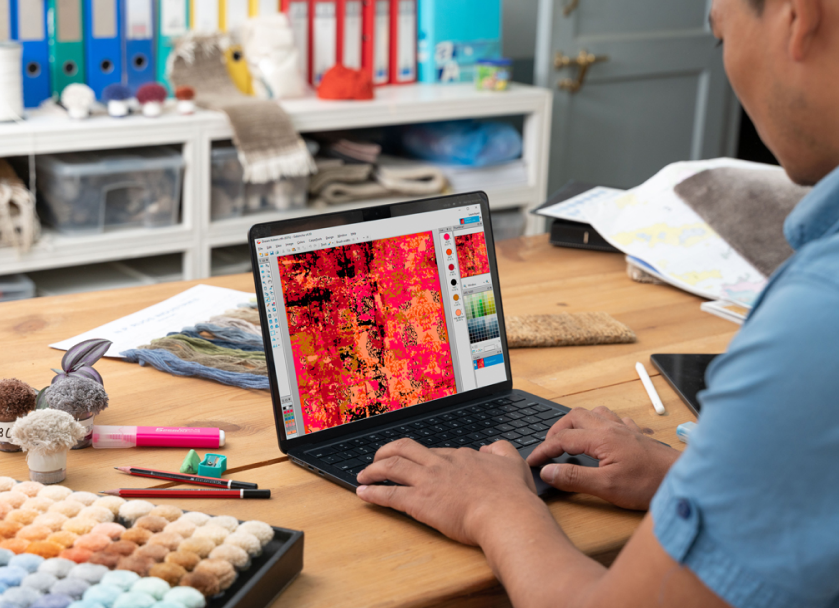
Nepal's weaving workshops produce the highest-density hand-knotted rugs in the world, using Himalayan wool sourced from high-altitude regions.India: The Mid-Market and Persian-Tradition Alternative
India is the world’s largest exporter of handmade rugs by volume. Its production ecosystem spans everything from village hand-tufting to premium hand-knotted work in the Mughal-Persian tradition.
India’s Genuine Strengths
1. Large Production Ecosystem and Price Range
The Jaipur, Agra, Mirzapur, and Bhadohi clusters collectively offer a wide range of manufacturers at varied price points. At the low end, hand-tufted rugs from Rajasthan workshops hit $12–18/sq ft FOB. At the high end, Jaipur Rugs and a handful of comparable manufacturers produce well-made hand-knotted pieces in the Persian-knot tradition.
2. India-Origin Brand Story
For importers whose buyers specifically want India-origin product – whether for aesthetic reasons (Jaipur provenance, Mughal design tradition) or market positioning – India’s origin story is authentic and marketable in its own right.
3. Faster Lead Times for Stocked Designs
For repeat orders using pre-stocked yarn and established designs, some Indian manufacturers can deliver hand-tufted in 6–8 weeks and hand-knotted in 12–16 weeks – faster than Nepal’s timeline for brand-new custom designs.
4. The Jaipur Rugs Ethical Model
Jaipur Rugs has built a well-documented artisan-to-market supply chain with weaver welfare programs. For importers specifically requiring an India-origin product with formal ethical backing, Jaipur Rugs is the credible option in this market.
India’s Honest Limitations
The fragmented supply chain is the structural problem. This deserves a direct explanation because it is the root cause of most quality complaints about Indian-origin rugs. India’s rug industry is geographically scattered: weaving is decentralised into village-level workshops across Rajasthan; yarn dyeing is frequently handled in separate industrial facilities in Haryana (Panipat) or other distant processing hubs. The handoffs between these stages — from dyer to transporter to weaver, across hundreds of kilometres – are where colour consistency breaks down, specifications get lost, and dye-lot variation enters a production run. This fragmentation is structurally built into how most of India’s rug industry operates at scale.
Quality consistency is supplier-dependent, not origin-wide. The quality range from a disciplined Jaipur exporter to an unvetted Mirzapur trader is enormous. Both are described as “sourcing from India.”
The quality inspection cost is a standard line item. Most experienced India importers budget for third-party QC inspection on every container – typically $250–$600 per visit. This is not optional; it is the cost of managing the fragmentation and specification risk.
Material substitution risk is higher at mid-to-lower price points. Viscose (synthetic silk) is routinely substituted for real silk; lower-grade wool blends replace New Zealand wool. Burn tests and pile weight checks are standard practice for experienced India importers.
Ethical certification is inconsistent at scale. While Jaipur Rugs is genuinely certified, the broader Indian industry cannot provide the systematic GoodWeave or equivalent audit trail that Nepal’s certification ecosystem delivers as a baseline.
Turkey: The European Proximity Advantage
Turkey occupies a unique position in the global rug market for one critical reason: the EU Customs Union.
Turkish-made goods, including rugs, enter the EU duty-free. For a European importer building a mid-to-premium product line, this is a structural cost advantage that Nepal and India cannot replicate. A 5% import duty on a €50,000 container is €2,500 – recovered in fewer than two medium Turkish orders.
Turkey’s Genuine Strengths
1. EU Duty-Free Access
This is the single most important structural advantage for European distributors. No other major rug origin country has this benefit.
2. Geographic Proximity to Europe
Transit times from Turkey to Central Europe are 5–10 days by road freight, versus 25–35 days by sea from South Asia. For importers who run tight inventory, need rush orders, or want to minimise working capital tied up in transit stock, Turkey’s proximity is a genuine operational advantage.
3. Distinct and Highly Marketable Aesthetic Tradition
Turkish rug design – particularly Oushak, Hereke, and kilim traditions – is distinct from Nepalese and Indian aesthetics. For importers who sell to a market with strong appetite for the Turkish aesthetic, this is an authenticity advantage that cannot be replicated by outsourcing Turkish-style designs to Nepal or India.
4. Strong Flatweave and Kilim Production
Turkey is the global leader in high-quality flatweave kilims. If your product line includes flatweaves, Turkey is almost certainly the right primary origin.
5. Faster Custom Lead Times for European Markets
12–16 weeks for fully custom hand-knotted, with faster options for semi-custom work using pre-dyed yarn inventories.
Turkey’s Honest Limitations
Price point is higher than India for comparable hand-knotted quality. Turkey does not compete on price at the volume tier. A Turkish hand-knotted rug at 80 KPSI will typically be priced 20–35% above a comparable Indian piece.
Knot density ceiling is lower than Nepal. The Hereke tradition produces extraordinarily fine work, but the broad base of Turkish hand-knotted production operates at lower knot densities (40–80 KPSI) than Nepal’s premium tier (80–150 KPSI). For the ultra-premium segment, Nepal’s artisan ceiling is higher.
Ethical certification infrastructure is limited. Turkey does not have an equivalent to GoodWeave. For importers whose buyers require formal ethical sourcing documentation, Turkey is harder to certify than Nepal.
The US tariff picture is less favorable than for Nepal. Turkey does not have GSP access to the US in the way Nepal historically has. For US importers, the duty structure makes Turkey less compelling outside of its aesthetic uniqueness.
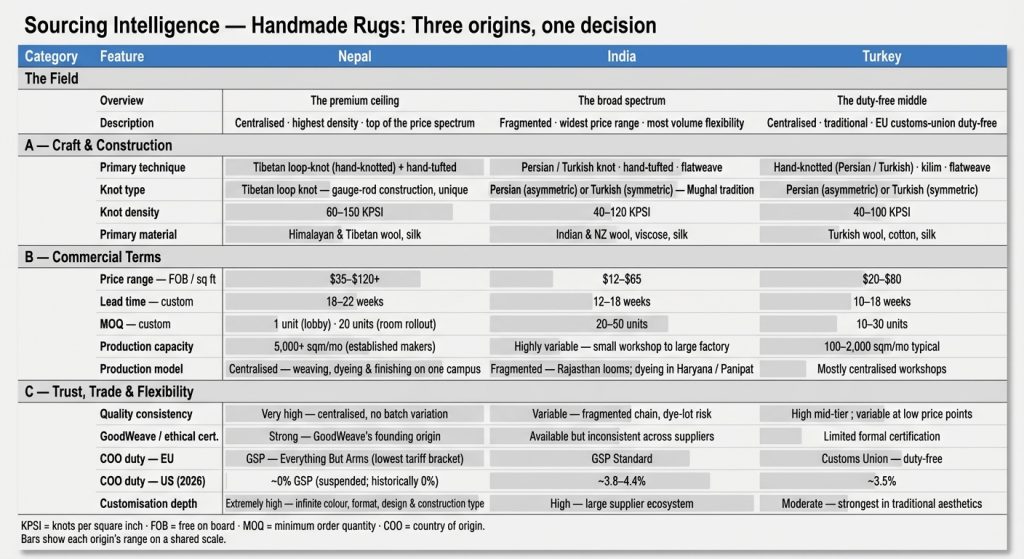
For US importers and European distributors, Nepal, India, and Turkey each occupy distinct positions in the global handmade rug market.The Hidden Costs of Sourcing from Each Origin
The FOB price on the invoice is rarely the whole story. Experienced importers track total landed cost – and the gap between FOB and landed cost varies significantly by origin.
| Factor | Nepal | India | Turkey |
|---|---|---|---|
| Quality Inspection (QC) | Occasional (high trust suppliers) | Standard (recommended every container) | Occasional to standard |
| Sea Freight Transit Time | 25–35 days (via India/Sri Lanka) | 25–35 days | 5–10 days road (EU); 15–20 days sea (US) |
| Import Duty (EU) | ~4–6.3% (LDC GSP) | ~4–6.3% (GSP) | 0% (Customs Union) |
| Import Duty (US, 2026) | GSP (suspended; ~0% historically) | ~3.8–4.4% | ~3.5% |
| Rework Rate (industry avg) | Low | Moderate (supplier-dependent) | Low to moderate |
| Ethical Cert / Audit Doc Cost | Included (GoodWeave / Label STEP) | Variable (must be sourced separately with uncertified suppliers) | Not widely available |
| Currency / Payment Risk | USD-denominated (stable) | USD/INR (moderate volatility) | EUR/TRY (Turkish lira historically volatile) |
| Sampling Cost | $150–$400 per strike-off sample | $80–$250 per sample | $100–$300 per sample |
Important
The Turkish lira factor: If you are paying a Turkish supplier in Turkish lira rather than EUR or USD, the currency volatility risk is real. Insist on EUR or USD denomination in your contracts. Turkish suppliers who export regularly will accommodate this.
When to Choose Nepal: The Exact Use Cases Where Nepal Wins
We said at the outset that this guide would be honest about where Nepal loses. Here, we are equally specific about where Nepal wins – and it is not a catch-all:
Choose Nepal when:
Your retail price point is $500+ on a 5×8 ft rug (or equivalent premium positioning)
Your product line is in the luxury residential or boutique hospitality segment
Your buyer explicitly requires GoodWeave, Label STEP, or equivalent ethical sourcing documentation
You need the Tibetan loop-knot construction — not interchangeable with Indian Persian-knot hand-knotted
You need ultra-fine work above 100 KPSI, or a complex multi-colour design requiring exceptional artisan skill
You are specifying a single large-format custom piece (hotel lobby, corporate reception, private residence)
You want both hand-knotted and hand-tufted production under one roof, one certification, one quality standard
You need serious production capacity (5,000+ sqm/month) at the premium tier without splitting across suppliers
You sell into a market where the “Made in Nepal” / Tibetan weave provenance is a genuine marketing asset
You need a highly durable commercial piece in 100% Himalayan wool that will outlast machine-made alternatives by decades
Consider India when:
Your retail category firmly operates at $150–$399 price points and the Tibetan-weave quality tier is above your margin structure
You want India-origin specifically as part of your brand story or buyer requirement
Your design aesthetic is rooted in the Persian or Mughal knotting tradition
You have an established supplier relationship, an active QC inspection protocol, and are comfortable managing a fragmented supply chain
Consider Turkey when:
You are a European distributor and the duty-free Customs Union advantage is material to your margin structure
Your market has strong demand for Turkish aesthetic traditions (Oushak, kilim, Anatolian)
You need fast replenishment lead times to European warehouses
Your product line includes flatweave kilims (Turkey is the best-in-class origin)
Frequently Asked Questions for Importers
Can I source from multiple origins simultaneously?
Yes — and experienced importers often do. A considered structure for US importers: Nepal for the premium tier of the line (hero pieces, custom contracts, hospitality contracts, pieces where Tibetan-weave construction and ethical certification are specifications), and Turkey for flatweave or European-market allocation. The key is recognising that Nepal and India are not interchangeable by volume — they produce structurally different products at different price tiers. Applying mid-market India price expectations to a Tibetan-weave Nepal specification will always produce a disappointing outcome.
How do I verify a manufacturer’s GoodWeave certification?
GoodWeave publishes a live licensee database at GoodWeave.org. Any manufacturer claiming active certification can be verified there in real time. Do not accept a certificate document alone — always verify directly with GoodWeave International. NP Rugs’ current certification status is publicly verifiable on the GoodWeave directory.
What are the typical payment terms for each origin?
Nepal: 30–50% deposit on order confirmation, balance before shipment. Letter of Credit (LC) is accepted by most established exporters. India: Similar deposit structure; large orders from established buyers can negotiate 30/70 or 20/80 terms. Turkey: More flexible terms for European buyers; some Turkish exporters will work on 30-day net from invoice for established relationships due to the geographic proximity reducing risk.
How do I find a legitimate manufacturer rather than a trading agent in each country?
The clearest signals: a manufacturer will invite you to visit their production facility; a trading agent will offer vague reasons not to. Request a video call walkthrough of the actual weaving workshop. In Nepal, legitimate manufacturers are registered with the Nepal Carpet Manufacturers and Exporters Association (NCMEA). In India, look for AEPC (Apparel Export Promotion Council) or CEPC (Carpet Export Promotion Council) membership. In Turkey, the Istanbul Textile and Raw Materials Exporters Association (ITHIB) is a verification point.
Ready to Start Your Sourcing Conversation?
NP Rugs exports directly to trade buyers in the US, UK, Europe, and the Middle East. We are transparent about our position in the market – we are a Nepal-origin, premium-tier manufacturer, and we will tell you honestly if your sourcing need is better served by a different origin or a different price tier.
If you are building or expanding a handmade rug product line and want an unbiased sourcing consultation from a manufacturer with 35 years of export experience, our team is ready to help.
Request a Sourcing Consultation – Send us your product brief, target price points, and volume requirements. We will respond within 48 hours with an honest assessment and, where appropriate, a sample proposal.
Direct Contact:
Email: info@nprugs.com
Phone (Nepal): +977-9765960464
About the Author
This article was prepared by the NP Rugs export team. Operating from Kathmandu since 1991, NP Rugs manufactures premium hand-knotted rugs for international trade buyers, retail importers, and commercial design firms. We hold continuous GoodWeave and Label STEP certifications and export to the US, EU, UK, Australia, and the Middle East.
Last updated: July 2026