
A hand-knotted rug is not maintenance-free. Nothing of genuine quality is. But the care it requires is specific, not intensive – and understanding what to do (and what never to do) is the difference between a rug that lasts three generations and one that deteriorates within a decade despite having the construction that should have made it last a century.
This guide covers the complete care system for hand-knotted rugs: routine maintenance, spill response by material type, professional cleaning, sunlight management, storage, and the repair vs replace decision. It applies to any hand-knotted rug, and specifically to NP Rugs hand-knotted rugs produced in Himalayan or New Zealand wool at our Kathmandu facility.
If you are a retailer or interior designer looking to pass this guide along to a client, you are welcome to share this page directly.
Why Hand-Knotted Rug Care Is Different
The care requirements of a hand-knotted rug differ from those of other rug types because of how they are made – and what they do not contain.
A hand-knotted rug has no adhesive backing. No latex. No secondary fabric layer. The pile is held in place entirely by the knots tied around the warp threads during weaving. This structure is the reason hand-knotted rugs can last 50–100+ years: there is nothing to degrade except the fiber itself, and quality Himalayan wool is exceptionally resistant to degradation under normal use.
By contrast, a hand-tufted rug has a latex or adhesive backing applied after the tufting process. This backing typically begins to break down after 15–25 years – a process called dry rot – which produces a crumbling, brittle texture underneath the pile. The pile may look fine while the backing is failing. The hand-knotted construction has no equivalent failure mechanism.
Understanding this changes how you think about care. You are not trying to prevent structural deterioration (the structure is inherently durable). You are managing the fiber, the dye, and the surface – which respond predictably to specific threats.
Routine Care: The Three Things That Matter Most
1. Vacuuming – The Right Way
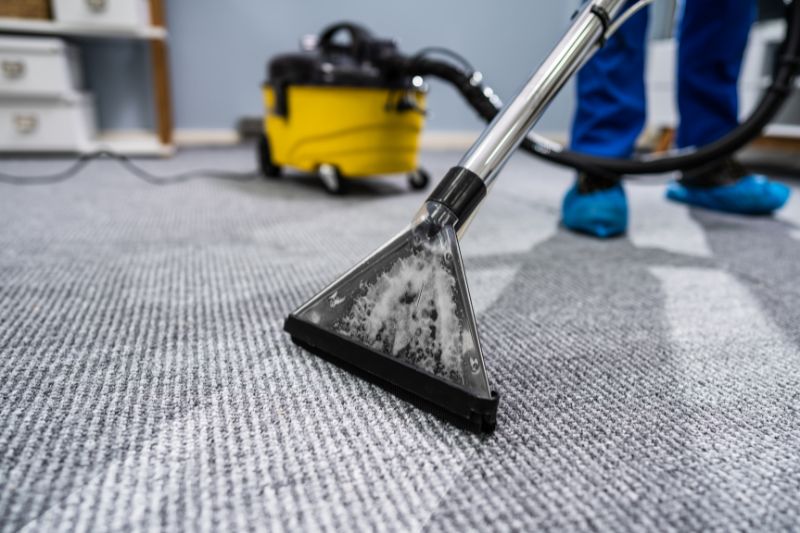
Vacuum a hand-knotted rug regularly – weekly in high-traffic areas, fortnightly in light-use rooms. This removes the dry particulate soil that settles between pile fiber and acts as an abrasive against the wool over time.
The single most important rule: no beater bar. Ever.
A rotating beater bar or power brush attachment catches and snaps individual knots in the pile. The damage is cumulative and irreversible – it produces progressive pile loss, fuzzing, and surface distortion that looks like wear but is actually mechanical destruction. Many owners damage a hand-knotted rug this way without realizing it, attributing the pile change to age.
Correct method:
- Set the vacuum to suction only (no rotating head)
- Vacuum along the direction of the pile – run your hand across the surface; the direction that smooths the pile flat is the correct direction to vacuum
- Fringes: vacuum gently with the suction nozzle or brush with a soft hand brush – do not run the vacuum head over fringes directly
- Back of the rug: turn the rug over and vacuum the back occasionally to remove embedded soil from below
2. Rotation
Rotate the rug 180 degrees every 12–18 months. This distributes two forms of wear evenly:
- Traffic wear – furniture legs, walking paths, and door proximity create localized compression and pile flattening. Rotation distributes this across the whole piece
- UV exposure – sunlight causes progressive color fading in any dye type. Rotation ensures that no single area of the rug receives disproportionate light exposure
For rugs in rooms with large south-facing windows or skylights, rotation is especially important. Consider UV-filtering window film or treatments for rooms where direct sunlight hits the rug for significant portions of the day.
3. Pile Direction Management
Hand-knotted rug pile has a direction – it lies one way naturally. Furniture placement, walking patterns, and vacuuming against the pile all affect how the pile sits. Occasionally brush the pile gently in its natural direction with a soft brush to restore the lay. This is more relevant for higher-pile pieces; low-pile and flatweave constructions are less sensitive to pile direction.
Spill Response: By Material Type
Wool Rugs
The high lanolin content in Himalayan wool provides natural water resistance – spills sit at the pile surface briefly before beginning to penetrate. Move quickly.
Immediate response:
- Blot (never rub) with a clean, dry, white cloth. Work from the outside edge of the spill inward to prevent spreading
- For water-based spills (wine, juice, coffee): apply a small amount of cold water to the blotted area, then blot again to lift remaining residue. Cold only – hot water opens the wool fiber and drives the stain deeper
- Blot dry thoroughly. Place a clean dry towel over the damp area and press firmly
- Allow to air dry completely before placing furniture back on that area
Never apply:
- Hot water
- Chemical carpet cleaners or upholstery sprays – these strip the wool’s lanolin coating and degrade the pile
- Baking soda directly on wool (it raises the pH and can affect dye stability)
- Steam cleaning (heat forces moisture into the foundation structure)
Wool-Silk Blend Rugs
Silk fibers are significantly more delicate than wool and must be treated accordingly. Silk is protein-based and reacts poorly to water – it can water-spot, pucker, and lose its luster if wet incorrectly.
Immediate response:
- Blot immediately with a clean, dry cloth – maximum speed, maximum pressure
- Do not apply water to a silk blend rug. The moisture risk to the silk fibre is greater than the stain risk
- For a spill that has penetrated: contact a specialist rug cleaner immediately. Do not attempt DIY treatment
- Allow the area to air dry completely
Never apply:
- Any water directly to the pile of a silk blend rug
- Any chemical treatment – silk is chemically sensitive
- Heat of any kind
Pure Silk Rugs
Pure silk rugs require specialist care for any cleaning beyond dry surface debris. Do not attempt any liquid cleaning at home. Any spill should be blotted dry immediately and the rug taken to a specialist rug cleaner within 24–48 hours.
What Never to Do to a Hand-Knotted Rug
This list is worth printing and keeping with the care documentation for any piece.
Never use a beater bar vacuum attachment. As covered above – mechanical pile destruction, cumulative and irreversible.
Never steam clean. Steam cleaning forces hot moisture into the pile base and warp/weft foundation. On a hand-knotted rug, this can distort the foundation structure, degrade the dye bonds, and encourage mould growth in the pile base if drying is inadequate.
Never use chemical carpet cleaners or foam sprays. These products are formulated for synthetic fibre construction, not natural protein fibres. Applied to wool, they strip lanolin, affect dye stability, and leave residue that attracts soil faster than an untreated pile.
Never fold a hand-knotted rug for storage. Folding compresses knots at the fold line and, over time, cracks the pile and distorts the foundation. Roll only.
Never store in plastic or non-breathable wrapping. Moisture trapped in plastic encourages mould growth in the pile. Use breathable cotton or muslin only.
Never place a wet rug back on the floor. A damp rug on a hard floor creates the conditions for mold growth at the foundation layer. Ensure the rug is completely dry – both pile and foundation – before replacing.
Professional Cleaning: How Often and What to Look For
Schedule
Have a hand-knotted rug professionally hand-washed:
- Every 3–5 years for rugs in regular residential use
- Every 2–3 years for rugs in high-traffic areas, homes with pets, or rooms with significant sunlight exposure
- When needed – if a spill cannot be resolved with blotting, or if the rug has accumulated soil that routine vacuuming does not address
What Professional Hand-Washing Involves
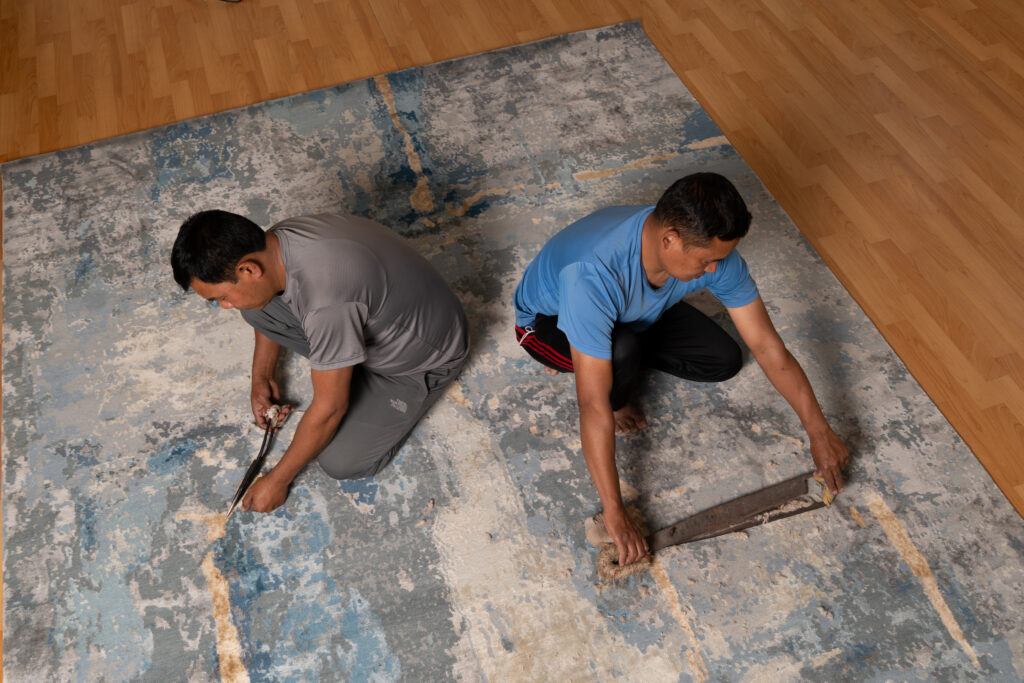
Correct professional cleaning of a hand-knotted rug is a full immersion hand-wash process. The rug is submerged in water (at appropriate temperature for the fiber type), gently worked to release embedded soil, rinsed fully, and dried horizontally or on a frame – never in a tumble dryer.
This is categorically different from:
- Machine washing (the mechanical agitation of a washing machine destroys pile and distorts the foundation)
- Steam cleaning (hot forced steam, as above)
- Dry chemical cleaning (solvent residue in wool pile)
How to Find a Qualified Rug Cleaner
Look for a specialist rug cleaner, not a general carpet cleaning service. Key indicators:
- They offer full immersion hand-washing (not just in-home cleaning)
- They distinguish between rug types and fibre types in their process
- They have experience with hand-knotted Oriental or Himalayan rugs specifically
- They can explain their drying process (horizontal air drying is correct)
In major US and European cities, specialist rug washing services exist that handle antique and high-value hand-knotted rugs. For a valuable piece, this is worth the additional cost over a standard carpet cleaning service.
Sunlight and UV Management
Sustained direct sunlight is the primary long-term color threat to any rug – natural or synthetic dye, wool or silk.
The practical guidance:
- Rugs in rooms with south-facing windows (in the northern hemisphere) receive the highest daily UV load – prioritize rotation and consider UV-filtering window film
- Move or cover valuable rugs during peak sunlight hours if direct sun falls on them for extended periods
- Natural-dyed rugs develop a patina under UV exposure – a softening and deepening of color that is characteristic and valued. Chrome-free synthetic dyes maintain more consistent saturation under the same conditions. Neither is immune to aggressive UV exposure over many years
Rug Storage for Seasonal Pieces
If a rug is going into storage for an extended period:
- Have it professionally cleaned before storage – never store a soiled rug. Embedded organic soil attracts moths
- Roll along the pile direction – pile facing inward, foundation facing out
- Wrap in breathable cotton or unbleached muslin – avoid plastic entirely
- Treat for moths before storage – place lavender sachets near (not in contact with) the wrapped rug. Cedar blocks are also effective. Do not use mothballs in direct contact with the pile – the naphthalene can interact with natural wool dyes
- Store horizontally – do not store a rolled rug upright for extended periods; the weight of the roll can distort the foundation
- Check every 3 months – unroll, inspect for moth activity or moisture, re-roll
Repair vs Replace: What Damage Is Recoverable
One of the major advantages of hand-knotted construction is that it can be professionally repaired. The repair options depend on the type and extent of damage.
What Can Be Repaired
Fringe wear or loss – fringes are the ends of the warp threads and can be replaced or re-twisted. This is a relatively simple repair.
Edge damage – the binding or overcasting on the rug’s edges can be replaced if worn or damaged. A specialist can re-bind the edge to match the original.
Localized pile loss – small areas of pile loss (from wear, burning, or cutting) can be re-knotted with matching yarn by a specialist. The repair is visible up close on the back of the rug but is typically undetectable from the front.
Moth damage – if caught early (before moth larvae have eaten through the foundation structure), moth-damaged areas can be re-knotted. If the foundation warp or weft threads have been severed, the repair is structurally more complex but still possible in many cases.
Color restoration – faded or stain-damaged areas can sometimes be re-dyed by a specialist. This requires matching the original dye exactly and is a specialist operation, but it is possible.
What Cannot Be Repaired
Foundation structural failure – if the warp threads (the vertical load-bearing structure of the rug) have been severed across a significant area – by moth, water damage, or cutting – the structural integrity of the piece is compromised. Repair is not always viable.
Latex backing failure (hand-tufted rugs only) – this is not relevant to hand-knotted rugs, which have no latex backing. But if a piece presented as hand-knotted has a failing latex backing on examination, it is almost certainly a hand-tufted rug, and the backing cannot be replaced.
Wholesale color loss from chemical damage – if a strong chemical cleaner has been applied across a large area and caused widespread dye stripping, the result is typically not recoverable.
Who Should Repair a Hand-Knotted Rug
The best outcome for any repair comes from the original manufacturer. At NP Rugs, we offer repair assessment for hand-knotted rugs produced at our facility – because we have access to the original yarn specifications, dye references, and knotting technique used in the piece. For rugs produced elsewhere, a specialist Oriental rug restorer is the appropriate choice.
For any repair enquiry, contact us with photographs of the damage and the rug’s approximate age and origin.
Lifespan: What to Expect
| Construction | Expected Lifespan (with correct care) |
|---|---|
| Hand-knotted (Himalayan wool) | generations |
| Hand-knotted (New Zealand wool) | 40–80 years |
| Hand-knotted (wool-silk blend) | 40–80 years with careful care |
| Hand-tufted (any material) | 15–25 years (latex backing is the limiting factor) |
| Machine-made (synthetic) | 5–15 years |
A hand-knotted rug is not a purchase – it is an investment in a piece that, with reasonable care, will outlast its first owner. Understanding the care requirements is what activates that lifespan.
Explore the NP Rugs Collection
NP Rugs is a GoodWeave and Label STEP certified hand-knotted rug manufacturer based in Kathmandu, Nepal. Established 1991. We produce hand-knotted rugs from 40 to 300 KPSI using the Tibetan loop-knot method.
If you are considering a custom hand-knotted rug for a residential or commercial project – or sourcing for a trade programme – explore our current range and production capabilities in the NP Rugs digital catalog.
View the Full NP Rugs Collection →
For trade accounts, custom production, or repair enquiries:
Frequently Asked Questions
Can you vacuum a hand-knotted rug?
Yes – suction only. Never use a rotating beater bar or power brush attachment. The mechanical action catches and snaps individual knots, causing irreversible pile damage. Set the vacuum to suction-only and vacuum along the pile direction.
How do you clean a hand-knotted rug at home?
Routine: suction-only vacuuming. Spills: blot immediately with a clean dry white cloth – never rub. For wool, a small amount of cold water can help lift a water-based stain; blot dry thoroughly. No chemical cleaners, no steam. Full clean: professional hand-wash specialist every 3–5 years.
How long do hand-knotted rugs last?
A properly maintained hand-knotted rug in quality Himalayan or New Zealand wool lasts for generations. The construction has no latex backing to degrade. The limiting factor is fiber condition and dye stability – both of which respond well to correct care.
Can a hand-knotted rug be repaired?
Yes. Fringe replacement, edge re-binding, localised pile re-knotting, moth damage treatment, and sometimes colour restoration are all within the scope of a specialist rug restorer or the original manufacturer. The repairability of hand-knotted rugs is one of their fundamental advantages over hand-tufted or machine-made alternatives. NP Rugs offers repair assessment for pieces produced at our facility.
Do NP Rugs hand-knotted rugs need a rug pad?
Not typically. NP Rugs hand-knotted rugs are woven in Himalayan wool, which gives them substantial weight – a 8×10 ft piece weighs approximately 4–4.5 kg per square meter. This weight keeps the rug in place on most hard floor surfaces without slipping. For very smooth polished floors or high-traffic zones, a thin non-slip mat adds stability. A thick cushioning pad is generally not necessary.
NP Rugs is a rug manufacturer in Nepal specialising in hand-knotted rugs. GoodWeave and Label STEP certified. Established 1991. 1,000+ active trade accounts. We export hand-knotted rugs to the US, Europe, and Australia. Production capacity: 4,000–5,000 sqm/month.