
Most buyers encounter KPSI on a rug spec sheet and treat it like a quality dial. Higher number, better rug. Turn it up.
This is the most common and most expensive mistake in rug sourcing.
KPSI is not a quality score. It is a production specification – one that only adds value when the design you’re ordering actually requires it. Mis-specifying it means paying more for something you cannot see in the finished piece.
At NP Rugs, we produce hand-knotted rugs from 40 KPSI up to 300 KPSI. That upper number surprises almost every client who hears it for the first time – most buyers assume Nepal maxes out at around 120. In this post, we explain what KPSI actually measures, what it does and doesn’t affect, and how to use it correctly when placing an order.
What KPSI Stands For and How It Is Counted
KPSI stands for Knots Per Square Inch. It measures how many individual hand-tied knots are woven into every square inch of a rug’s pile surface.
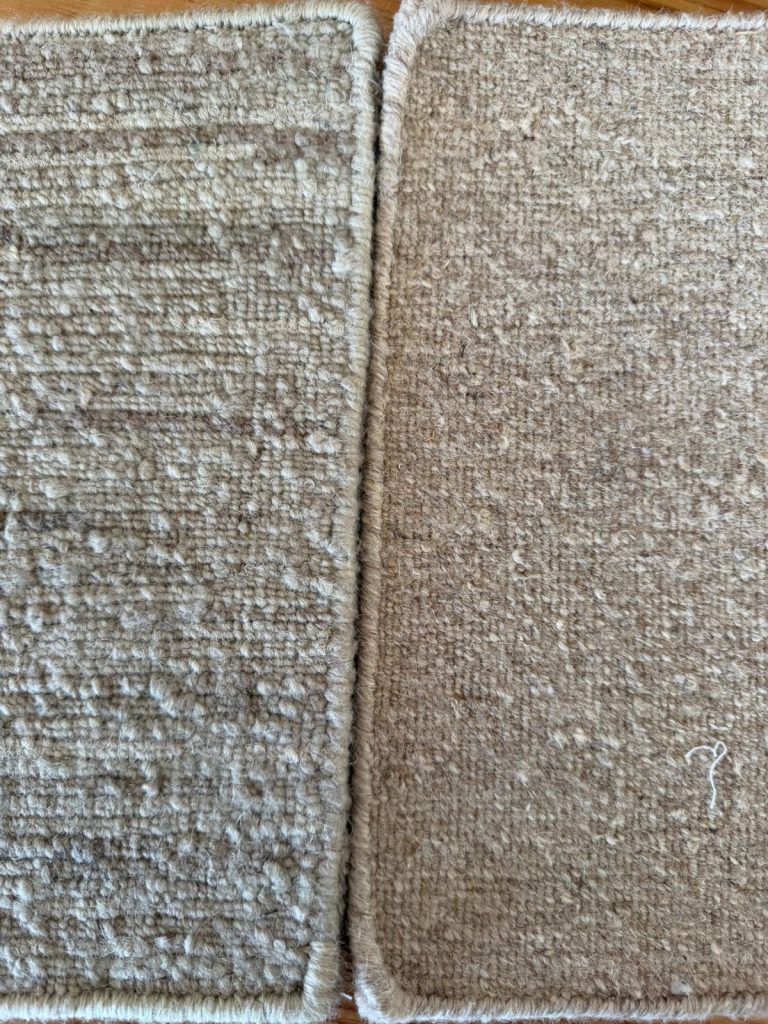
To count KPSI on a completed rug, turn it over and count the knot tufts visible on the back in a one-inch-by-one-inch square. Each tuft is one knot. A 60 KPSI rug has 60 of these per square inch. A 200 KPSI rug has 200.
The easiest way to understand KPSI: think of your phone screen.
Your smartphone screen is measured in PPI – pixels per inch. The original iPhone launched in 2007 at 163 PPI. An image displayed on it looked blocky up close – you could see the individual pixels. By 2010, the iPhone 4 introduced the Retina display at 326 PPI. The same image suddenly looked sharp: fine text was crisp, curves were smooth, gradients were seamless. Nothing changed about the image itself. The resolution of the display changed – and that determined how much detail was actually visible.
KPSI works exactly the same way. Each knot in a hand-knotted rug is a pixel. The pattern is the image. At 60 KPSI, your design is being displayed at “old iPhone” resolution – bold shapes and large blocks of color look great, but fine curves and intricate details will appear stepped or blocky. At 120 KPSI, you’re at Retina resolution – fine florals, shading gradients, and delicate border motifs are fully rendered, exactly as intended.
The key insight is the same as with screens: higher resolution only improves the result if the image has detail that requires it. Displaying a plain red wallpaper on a 326 PPI screen looks identical to displaying it at 163 PPI. Similarly, a bold geometric rug at 120 KPSI looks identical to the same rug at 60 KPSI. The extra knots, like the extra pixels, have no design detail to resolve – so they produce no visible improvement. They just cost more.
What KPSI does not mean: higher durability in isolation, heavier weight, or universally better quality. Those relationships are more complicated than the number suggests.
The Tibetan Loop-Knot: Why Nepal’s Method Is Different
Before going further into the KPSI tiers, it is worth explaining the knotting method NP Rugs uses – because it directly affects how knot density is achieved and what it delivers.
NP Rugs produces all hand-knotted rugs using the Tibetan loop-knot, also known as the gauge-rod method. In this technique, yarn is looped over a gauge rod that runs horizontally across the warp. A blade then cuts the loops, producing a pile that is precisely and uniformly level across the entire rug surface. The pile height is controlled by the thickness of the gauge rod.
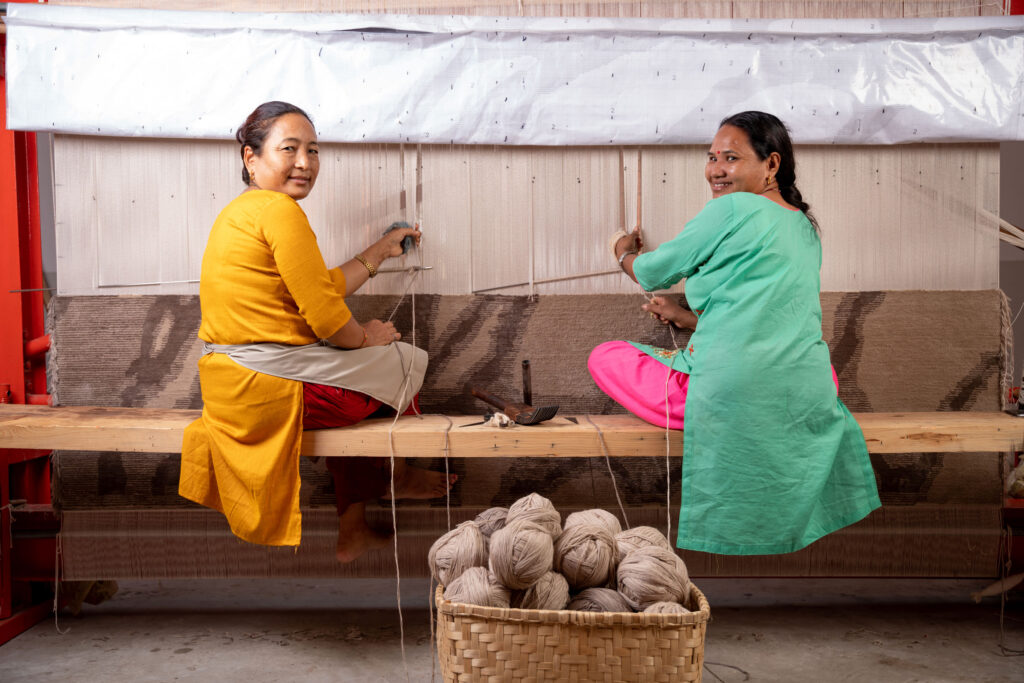
This is categorically different from the Persian (Senneh) or Turkish (Ghiordes) knotting methods used in Middle Eastern and Central Asian rug traditions. In those traditions, each knot is tied individually around one or two warp threads.
Why the Tibetan method enables higher KPSI: The gauge-rod system allows weavers to work with very fine yarn at very tight intervals – producing the consistent high-density pile that makes counts above 120 KPSI achievable without sacrificing pile uniformity. It is the reason Nepal has become one of the world’s premier sources for ultra-fine hand-knotted production. A 300 KPSI rug, which represents some of the finest hand-knotted work produced anywhere in the world, is achievable in Nepal precisely because of this method.
KPSI Tiers: What Each Range Delivers
Here is how to read the KPSI tiers in production terms. These are the ranges we work with at NP Rugs.
| KPSI Range | Tier | Best For | Design Limitation |
|---|---|---|---|
| 40–60 KPSI | Entry | Bold solids, thick stripes, large-scale geometric | Fine curves and gradient shading not possible |
| 60–80 KPSI | Standard | Geometric patterns, simple florals, tribal motifs | Good for most commercial and hospitality briefs |
| 80–100 KPSI | Premium | Detailed florals, medallion designs, multi-colour patterns | Handles moderate design complexity well |
| 100–120 KPSI | High Quality | Fine florals, traditional Persian-inspired patterns, fine borders | Resolves complex design at full fidelity |
| 120–180 KPSI | Master Grade | Pictorial designs, intricate traditional motifs, portrait-adjacent work | Requires an experienced specialist weaver |
| 180–300 KPSI | Ultra Fine | The finest pictorial work, collector-grade pieces, maximum design resolution | Extended production time; premium artisan skill required |
The key insight from this table: there is a wide jump in artisan skill, time, and material cost between 60 KPSI and 180 KPSI. That jump only produces a visible difference in the finished rug if the design actually uses it. A solid field with a simple geometric border looks identical at 60 KPSI and at 180 KPSI – but the 180 KPSI version costs dramatically more to produce.
What KPSI Actually Affects
Design Resolution
This is the primary function of high KPSI. More knots per inch means more individual color-change points per inch. The result: curves are smoother, shading gradients are possible, fine detail in borders and medallions is fully rendered. If your design has these elements, KPSI earns its cost. If it doesn’t, the extra knots produce nothing visible.
Pile Density and Texture
Higher KPSI produces a denser pile – the fibers are packed more tightly together. This has a tactile effect: a 120 KPSI rug has a noticeably different hand feel than a 60 KPSI rug. The higher-density pile also tends to hold its surface better under the light pressure of furniture and light foot traffic.
Production Time and Cost
A single artisan can tie approximately 10,000–14,000 knots per day. Doubling the KPSI per square inch more than doubles the production time, because the artisan is covering the same physical area with more knots and finer yarn. This is the primary reason KPSI drives cost – not material cost (which increases only modestly), but artisan hours, which scale directly with knot count.
Weight – What Most People Get Wrong
A common assumption is that a higher KPSI rug is heavier. In practice, the reverse is often true. At lower KPSI, individual knots are larger – more yarn per knot, more material per square inch. At 100+ KPSI, the knots are finer and more numerous, but each knot uses less yarn. The average weight of a hand-knotted rug from production is 4–4.5 kg per square meter, and this figure is driven more by pile height than by knot density. A rug with mixed pile heights – some areas high, some low – will be significantly heavier than a uniform-pile piece at the same KPSI.
When Higher KPSI Is Worth It
Your design has fine curves or intricate pattern work. A traditional Persian floral with fine vine scrolls, a medallion with detailed secondary motifs, a pictorial design with faces or architectural detail – these designs require high KPSI to be rendered correctly. Producing them at low KPSI produces a jagged, blocky approximation of the intended design.
You want a collector-grade or heirloom piece. At 150+ KPSI, a rug enters territory where its production complexity is itself a statement of quality. These are not production items – they are objects that take months of specialist artisan time and that retain their value over generations.
Your specification requires fine shading or colour gradients. Abrash effects, graduated colour fields, and painterly backgrounds all require high knot density to be executed cleanly. At low KPSI, these effects become stepped rather than gradual.
The project has a high-visibility placement. A hotel lobby centerpiece, a flagship showroom installation, or a residential focal point where the rug will be seen at close range – in these placements, fine design resolution is visible and appreciated.
When Higher KPSI Is Not Worth It
Your design is bold and geometric. A simple geometric rug – solid color field, clean stripe, large-scale tribal motif – achieves its full visual effect at 60–80 KPSI. There is no design detail that would benefit from a higher count. The extra cost of a higher specification produces zero visible return.
The rug is for a high-traffic commercial space. For corridors, open-plan offices, retail floors, and other high-traffic applications, a 60–80 KPSI rug with a robust Himalayan or New Zealand wool specification will perform more practically than an ultra-fine piece. High-KPSI rugs with fine pile are not the right choice for every commercial application.
The project is budget-controlled. If a client has a fixed budget, keeping the KPSI at the level the design actually requires – rather than specifying the highest number the budget might theoretically reach – is how you get a correctly executed rug. An over-specified KPSI on a simple design wastes the budget on invisible quality.
You don’t have a final design yet. Specifying KPSI before the design is confirmed is a common and costly mistake. We see it regularly: a buyer specifies 120 KPSI for a project that turns out to be a simple geometric – and pays the 120 KPSI rate for a result that 60 KPSI would have produced identically. Design first, then specify KPSI.
The good news: you don’t need a finished design to start. NP Rugs has an in-house design team that will render your concept into a full digital visualization at zero cost – no production commitment required. Bring a rough sketch, a mood board, a reference image, or even a written description of what you’re imagining. We produce a photorealistic rendering of the finished rug, in your dimensions and color direction, before a single knot is tied. Once you can see the design, the correct KPSI becomes obvious. Send us your concept and we’ll render it free
The Surprise Most Buyers Have: Nepal Can Do 300 KPSI
Most buyers who come to us have been told – by other manufacturers, by brokers, or by common industry assumption – that Nepal produces rugs in the 80–120 KPSI range. They are routinely surprised to learn that NP Rugs produces rugs up to 300 KPSI.
This is not a recent development. It is the result of Nepal’s Tibetan knotting tradition, which evolved specifically to achieve high knot density with the fine Himalayan and Tibetan wool fibers that are native to the region. At 300 KPSI, we are in the territory of the world’s finest pictorial rug work – pieces that take the better part of a year to weave, that use the finest silk-blend yarns, and that represent some of the most technically demanding production in the handmade rug industry.
We are not the right partner for every 300 KPSI enquiry – the lead time, cost, and artisan skill requirement make this production tier suitable for specific projects only. But the fact that we can produce it speaks directly to the range and technical capability of our Kathmandu facility.
How to Specify KPSI in a Purchase Order
Here is the correct sequence:
- Submit your design first. Send us your design file – whether that is a CAD drawing, a mood board reference, a hand sketch, or a verbal concept. If you have nothing yet, our in-house design team will render your concept for free before any production commitment.
- We recommend the KPSI range. Based on your design complexity, we advise the minimum KPSI required to render the design correctly, and the range within which you can meaningfully improve the result. This recommendation is specific to your design – not a generic tier suggestion.
- We produce a KPSI sample if required. For clients who want to evaluate pile density and texture before committing, we produce physical samples at different KPSI levels in your specified material. Clients regularly request samples at two knot counts to compare the pile feel and design resolution side by side before choosing a specification.
- KPSI is locked in the specification sheet. Once confirmed, the KPSI is fixed in the specification document that governs production. What is quoted is what we weave.
A Note on Verifying KPSI Claims
Not every KPSI figure quoted by a manufacturer is independently verifiable before delivery. Here is how to protect yourself:
Ask for a sample, not a promise. A pre-production KPSI sample – even a 15×15cm swatch – shows you the actual knot density you will receive. Count the knots on the back of the sample yourself. The number you count should match what was quoted.
Request the specification sheet in writing. Your purchase order and the manufacturer’s production spec sheet should both state the confirmed KPSI. If the supplier is reluctant to commit this to paper, that is information worth having.
Compare the back of the rug on delivery. When the finished rug arrives, counting the back confirms whether the delivered KPSI matches the specification. It takes two minutes. On a large order, this is always worth doing.
At NP Rugs, every order is accompanied by a specification sheet documenting the confirmed KPSI, material, pile height, and finishing specification. We do not adjust these during production without your explicit written approval.
Frequently Asked Questions
Can I order a rug at 300 KPSI?
Yes. NP Rugs produces hand-knotted rugs from 40 KPSI to 300 KPSI. Orders above 150 KPSI require a detailed design review – the design complexity must justify the production specification. We’ll tell you honestly if your design would look identical at a lower count. Lead times for very high KPSI production are extended; confirm at the quote stage.
Does a higher KPSI rug last longer?
Durability in a hand-knotted rug is primarily a function of material quality and pile height, not knot density. A 60 KPSI Himalayan wool rug with a full pile height will outlast a 120 KPSI rug in an inferior material under the same conditions. Specify KPSI for design resolution – specify material for durability.
My supplier quoted me 100 KPSI. How do I verify it?
Turn the rug over and count the knot tufts in a one-inch square on the back. Do this in several locations across the rug and average the counts. The number should match the specification within a reasonable range (±5 KPSI is normal production variation; larger discrepancies warrant investigation).
Is there a standard KPSI for hotel and hospitality rugs?
Not a single standard, but most hospitality projects fall in the 60–100 KPSI range. A 60–80 KPSI specification handles the design requirements of most commercial briefs at a practical price point. High-profile installations in premium properties – lobby center-pieces, VIP suite feature pieces – often specify 100–120 KPSI for the design complexity they involve.
Request a KPSI Sample
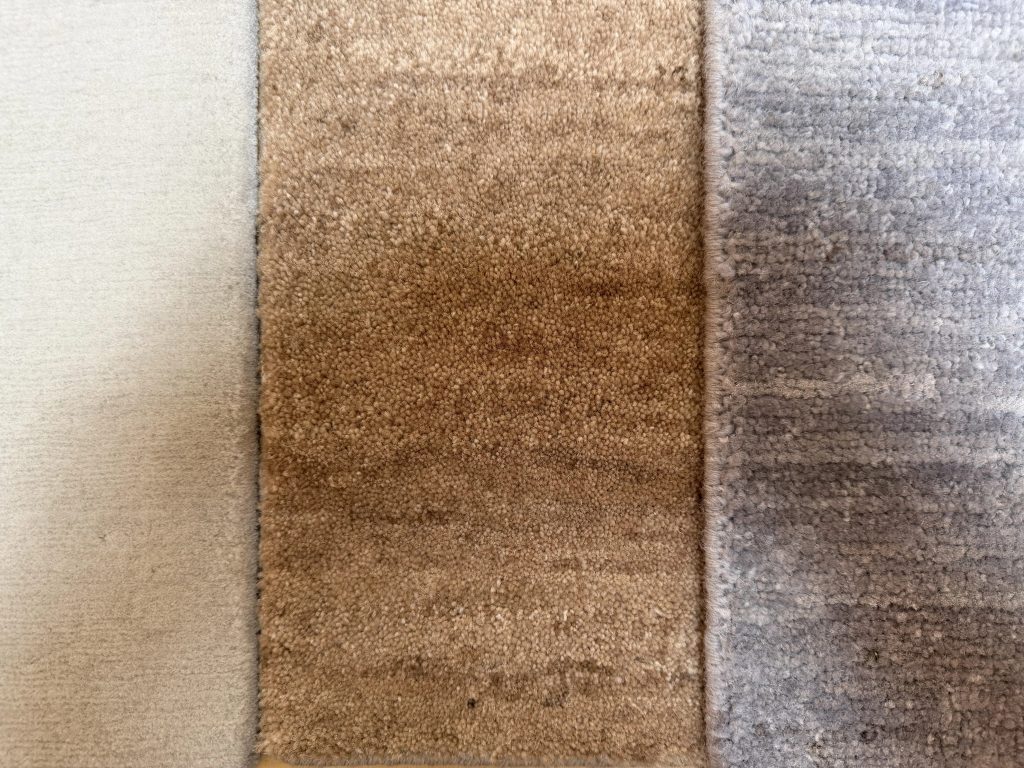
The best way to understand knot density is to hold it. A 60 KPSI pile and a 100 KPSI pile in the same material, at the same color, feel and look noticeably different in person.
We send KPSI sample packs to qualified trade buyers – two or more swatches at different knot counts in your specified material, so you can compare density, texture, and design resolution side by side before committing to a specification.
If you have a project in mind, include the design direction and approximate size in your enquiry and we’ll advise the KPSI range before sending samples.
NP Rugs is a GoodWeave and Label STEP certified hand-knotted rug manufacturer based in Kathmandu, Nepal. Established 1991. We produce hand-knotted rugs from 40 to 300 KPSI using the Tibetan loop-knot method. Production capacity: 5,000+ sqm/month. We export to the US, Europe, and Australia.