
Every serious buyer asks this question. Most manufacturers refuse to answer it.
We’re going to answer it – not with a flat number, because one doesn’t exist, but with something more useful: a clear explanation of the six factors that actually determine what your rug costs. By the end of this post, you’ll understand how a quote is built, what drives the price up or down, and what to have ready before you request one.
This post is written for US importers and trade buyers placing their first order from Nepal. If you’ve already sourced from us before, you know how this works. If you haven’t, this is the guide we wish every new buyer read before their first enquiry.
Why Rug Manufacturers Don’t Publish Prices – and Why We’re Writing This Anyway
The handmade rug industry protects pricing for real reasons, most of which aren’t in your interest as a buyer.
The standard justifications are: prices vary by piece, materials are volatile, and each order is different. These are true. But the actual reason most suppliers don’t publish pricing is simpler: it makes negotiation easier for them, harder for you.
A buyer with no pricing context has no way to evaluate whether a quote is reasonable. That ambiguity helps the seller. And in an industry where price signals quality – and quality varies enormously between suppliers – opacity is a tool.
We publish this because we want the buyers we work with to come in informed. A buyer who understands what drives price asks better questions. They specify correctly. They don’t confuse cheap quotes with good value or dismiss a higher quote without understanding what it includes. In our experience, informed buyers become better long-term partners.
So: here is how custom hand-knotted rug pricing actually works.
The 6 Factors That Determine What Your Rug Costs
Pricing a custom hand-knotted rug is not a formula – it’s a calculation. We price every enquiry individually based on the specification you submit. However, every price is built from the same six inputs.
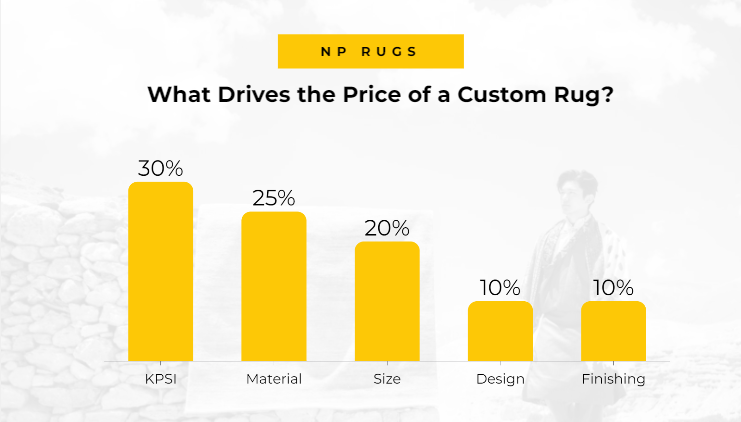
1. Knot Density (KPSI – Knots Per Square Inch)
Knot density is the single biggest variable in the price of a hand-knotted rug, and it’s the factor buyers most often misunderstand.
KPSI measures how many individual knots are woven per square inch of pile. A higher count means more artisan hours, finer design resolution, and a denser, more durable pile. It also means a significantly higher price per square metre.
The important thing to understand about KPSI is that it is not a quality dial you simply turn up. Higher KPSI is only worth paying for if your design requires it. A bold geometric pattern at 60 KPSI looks exactly as intended. The same rug at 120 KPSI costs nearly double and provides nothing extra – because the design doesn’t have the fine detail that high density is built for.
When we quote a client at NP Rugs, one of our first questions is: does the design justify the specified knot count? If it doesn’t, we say so. We don’t quote you for KPSI you don’t need.
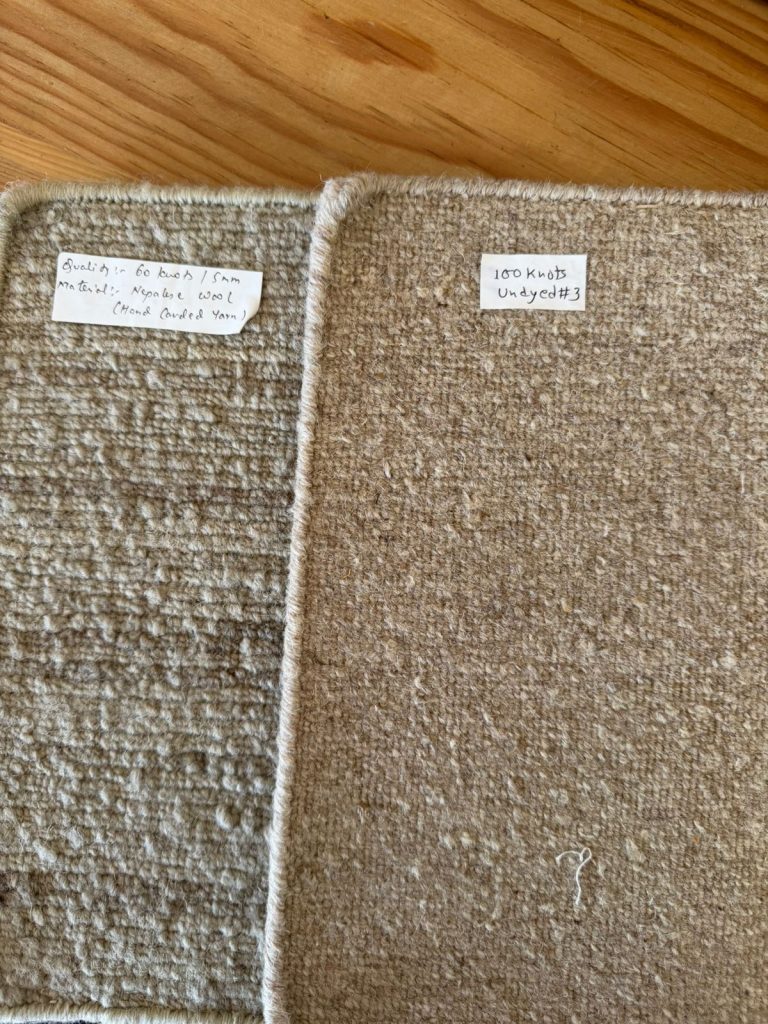
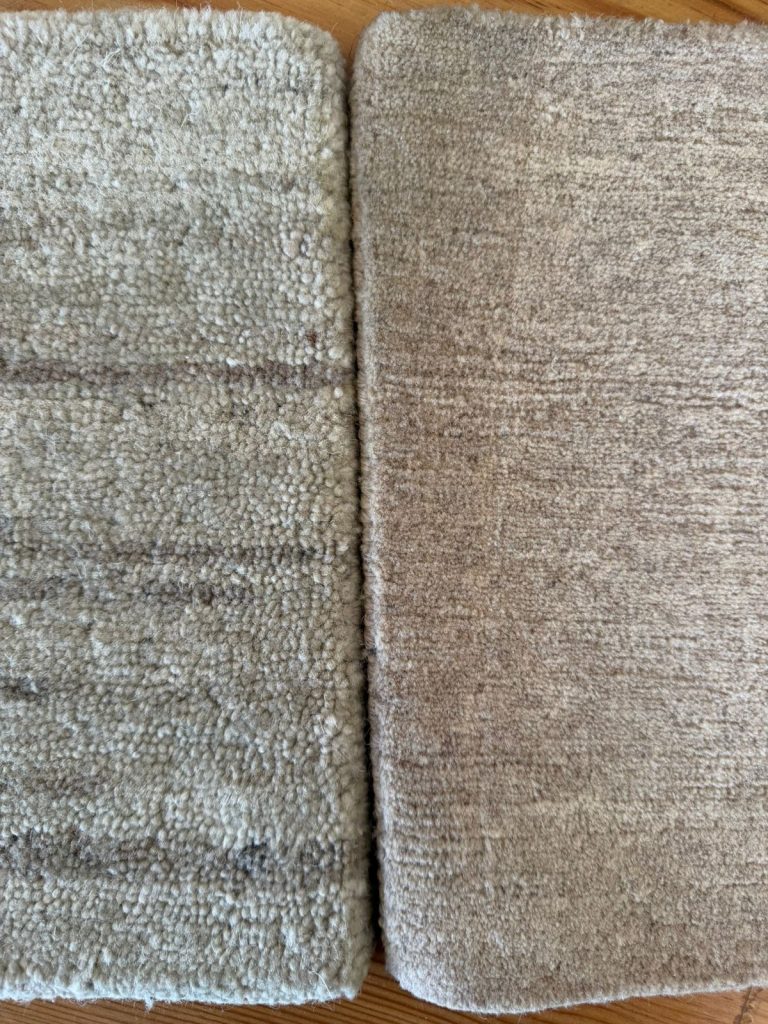
Pile density comparison: lower KPSI (left) vs higher KPSI (right). Higher knot count allows finer design detail – but only makes sense if your design requires it.
What this means for your quote: Specify the design first, then we’ll recommend the appropriate KPSI range. If you specify KPSI without a design, you may be quoted for more complexity than the final piece requires.
2. Size
Size is the most straightforward driver, but its effect is often underestimated.
We price hand-knotted rugs per square metre. Consequently, doubling the size doesn’t just double the price – it more than doubles it. This happens because larger rugs require continuous warp threading, longer loom setup, more material handling, and more complex finishing and stretching. For instance, a 4×6m lobby piece doesn’t cost twice what a 2×3m piece costs at the same specification. It costs significantly more per square metre as well as per piece.
The practical implication: for large commercial or hospitality projects, early size confirmation is important. Changing from 4×6m to 5×8m mid-production is the equivalent of starting over.
At NP Rugs: We handle production runs from a single bespoke piece to 5,000+ square metres per month. Our capacity means large orders don’t require extended waiting on loom availability – but they do require confirmed specifications before production begins.
3. Material
After knot density and size, material choice is the largest price variable.
The main materials used in hand-knotted rugs from Nepal:
Himalayan / Tibetan Wool
This is what Nepal is known for. High-altitude sheep in the Himalayan and Tibetan plateau regions produce a long-staple, high-lanolin wool. Furthermore, this wool is denser, more resilient, and more vibrant under dye than most alternatives. While it is more expensive than NZ or Indian wool, the difference is clearly visible and tactile in the finished rug. Additionally, it outlasts alternatives by a significant margin.
New Zealand Wool
The global standard for mid-tier hand-knotted production. It offers consistent quality, wide availability, and good performance. Therefore, we use New Zealand wool in a large proportion of our production where clients want excellent quality without the premium associated with Himalayan fibre.
Silk
We never use silk as the sole material for a full rug. Instead, weavers use silk as an accent – typically 15–20% in a wool-silk blend – to create sheen, add depth to colour, and produce a visual contrast in the pile. A 100% silk rug certainly exists, but it requires extreme production care, commands the highest material cost, and is not what most commercial buyers require.
Wool-Silk Blend
The premium specification for most high-end residential and boutique hospitality projects. Ultimately, the silk component adds luxury without the fragility of a full silk piece.
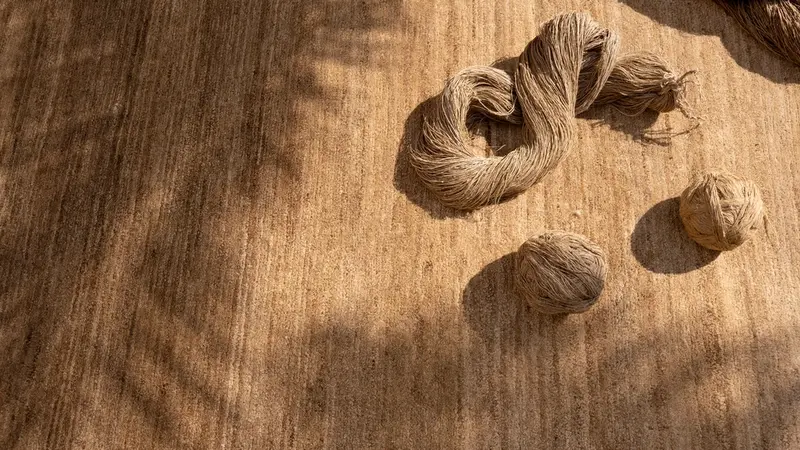
What this means for your quote: Material choice is a budget decision as much as an aesthetic one. When we quote you, we’ll confirm your material specification and explain the performance and cost trade-offs if you’re undecided.
4. Design Complexity
A plain-weave or simple geometric rug is faster to produce than a multi-colour floral with curved motifs and intricate borders. That difference in artisan time is reflected in the price.
Design complexity affects pricing in two ways: the number of colours used (each additional dye colour is a production variable), and the intricacy of the pattern (fine curves, graduated shading, and detailed medallions require higher skill and slower weaving speed).
In our factory, when a client submits a highly complex design at a standard KPSI, the weaving time can increase by 30–50% compared to a geometric design at the same count. That labour difference goes into the price.
You don’t need a finished design to start. NP Rugs has an in-house design team. If you have a rough sketch, a reference image, a color palette, or even just a concept – we will create a full digital rendering of the rug at no cost, before any commitment is made. The rendering shows you the exact pattern, color layout, and proportions at your specified size. Once the rendering is approved, it becomes the production reference for the weaver. This service is included as part of the enquiry process, not charged separately.
What this means for your quote: You don’t need a finalized design before you contact us. Bring your idea – in any form – and our design team will develop it into a production-ready rendering.
5. Pile Height
Pile height – the length of the knotted yarn above the warp – affects both material consumption and finishing time.
A deeper pile uses more yarn per knot. It also requires more careful shearing, levelling, and finishing to achieve a clean, even surface. For certain high-traffic commercial applications, a lower pile height is actually preferable: it recovers better under foot traffic and is easier to maintain.
For residential or design-led pieces, pile height is often specified for aesthetic reasons – a lush, deep pile for a bedroom, a flatter cut for a dining room or hotel lobby corridor.
What this means for your quote: We’ll ask about intended use as part of the specification process. Pile height is both a design and a performance decision, and it has a real cost implication.
6. Finishing
Finishing is the step between a completed weave and a delivered rug, and it is where quality either holds or fails.
Finishing at NP Rugs includes: washing, shearing (levelling the pile to a uniform height), stretching and blocking (ensuring the rug is dimensionally accurate and flat), edge binding, final quality inspection, and QC documentation. For export orders, it also includes pre-shipment inspection, packing, and documentation preparation (commercial invoice, packing list, GoodWeave certificate, certificate of origin).
Finishing is a real cost that cheap quotes often compress or skip. A rug with poor finishing is immediately visible: uneven pile, irregular edges, dimensional distortion. These are not defects in the weave – they’re defects in the finishing process.
What this means for your quote: Ask any supplier to describe their finishing process. If the answer is vague, that’s a signal worth investigating.
What the Price Actually Buys
When a quote comes back from a reputable hand-knotted rug manufacturer, you’re not paying for the rug in isolation. The price includes a stack of costs that are invisible in the final piece but essential to its quality and to your business.
Artisan Hours
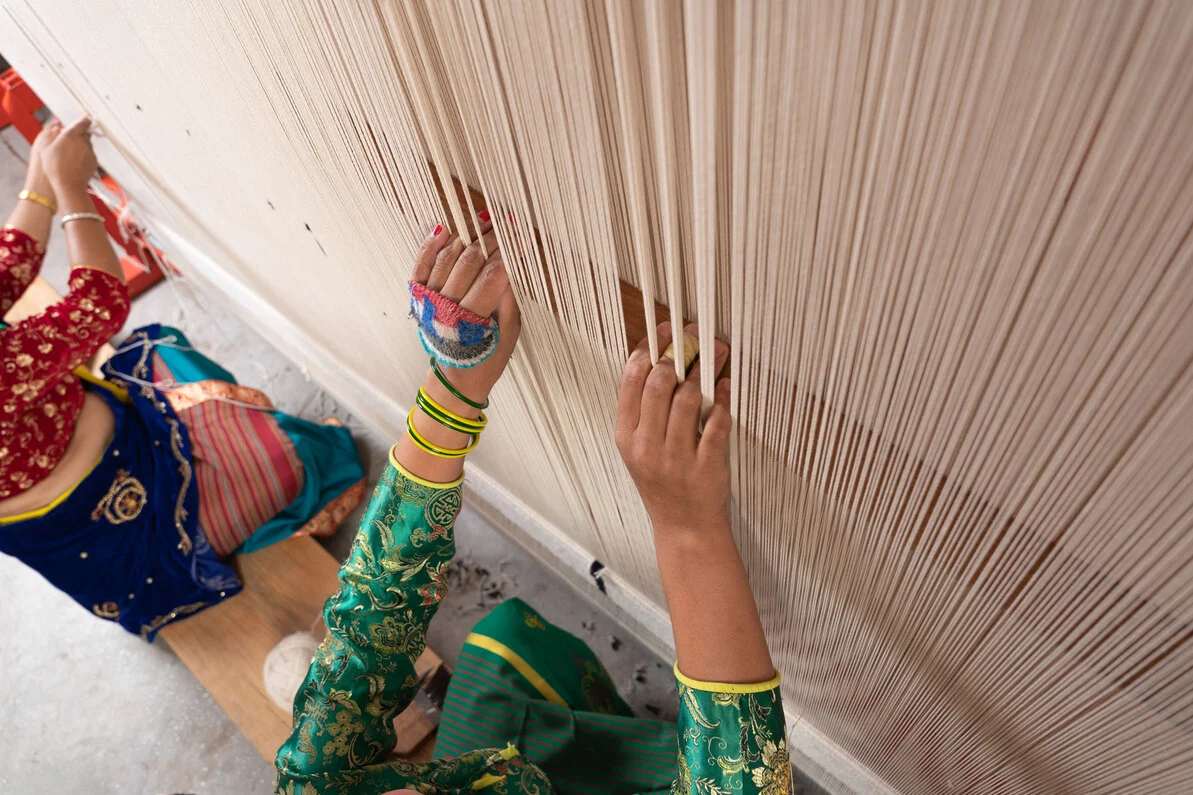
Hand-knotting is slow by design. A single artisan can tie approximately 10,000–14,000 knots per day under good working conditions. For example, a 9×12 foot rug at 80 KPSI contains roughly 9 million knots. That is, approximately, 700–900 artisan-days of work. The artisan’s skill, wages, and working conditions are embedded directly in the price. This is exactly why the labour cost in a hand-knotted rug cannot be compressed without compromising the piece itself.
Material Quality
The fibre that goes into the rug represents a significant portion of the total cost. Himalayan wool, properly sourced, is more expensive than substitutes. Similarly, natural dyes require more preparation and time than chemical alternatives. These premium inputs are either in the rug or they’re not — and their absence definitely shows up over time.
Certification Overhead
NP Rugs holds GoodWeave and Label STEP certification. Both require annual third-party audits of our factory, our production records, our artisan employment conditions, and our supply chain. Consequently, these audits have real costs: fees, preparation time, documentation, and the ongoing operational standards required to pass them. When you buy from a GoodWeave-certified manufacturer, part of what you’re paying for is the audit that verified the claims on the certificate.
QC Documentation
Every order that leaves our factory is accompanied by a documentation package: production records, pre-shipment inspection report, GoodWeave certificate, packing list, certificate of origin, and commercial invoice. Preparing accurate documentation is intensive labour. However, it protects your customs clearance, your compliance requirements, and your client’s paperwork if they need to document ethical sourcing.
What FOB Price Does Not Include
When we quote FOB (Free On Board), that price covers the rug from raw material through to loaded onto the vessel at the export port. It does not cover:
- Ocean freight – from origin port to destination port (your freight forwarder arranges this)
- Marine insurance – buyer’s responsibility unless specified otherwise
- Import duty – varies by country and HS code; US buyers should confirm Nepal’s trade status for the current year
- Customs broker fees – strongly recommended for first-time Nepal importers
- Inland delivery – from destination port to your warehouse
- Destination terminal charges – varies by port
A practical estimate for US buyers: add 15–25% to the FOB price to arrive at a rough landed cost, depending on freight mode (sea vs. air), volume, and current rates. This is a working approximation only – your freight forwarder will give you accurate figures once the shipment is specified.
What a Strike-Off Sample Covers
Before full production begins on any custom order, we produce a strike-off sample. This is a small woven section – typically 30×30cm or 50×50cm – produced in your confirmed specifications.
The strike-off shows you:
- Exact colour accuracy against your approved references
- Pile height and texture in the actual material
- Pattern execution at the specified KPSI
- Sheen characteristics (relevant for wool-silk blends)
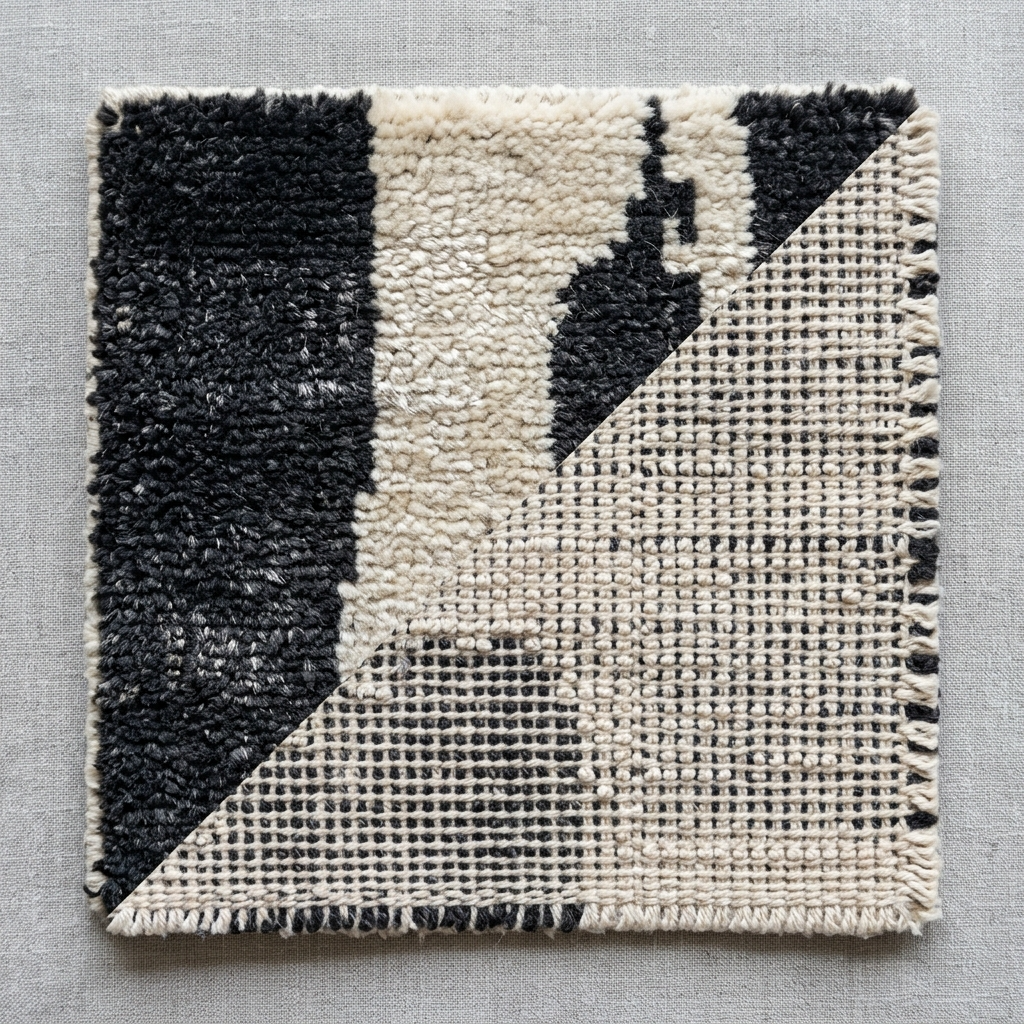
We charge separately for strike-off samples because they require real artisan hours, yarn, and dye. We confirm the cost at the quote stage. Fortunately, in most cases, we credit the strike-off fee against the final order.
Skipping the strike-off to save time is the most common mistake first-time buyers make with a new manufacturer. A strike-off that reveals a color correction costs a fraction of what it costs to remake a finished rug.
Why Cheap Prices Are a Signal to Investigate
In almost every other product category, competitive pricing is straightforward: lower price, same specification, better value.
Hand-knotted rugs don’t work this way.
The labour time in a hand-knotted rug cannot be compressed without making fewer knots per inch (lower KPSI), using cheaper fibre, paying artisans less, or cutting corners in finishing. A quote that is dramatically below market for a specified construction type means one of those compressions has happened – and in most cases, you won’t find out which one until the rug arrives.
Questions worth asking when a quote seems low:
- What material is specified, and can I verify the grade?
- What KPSI is being quoted, and how was that determined?
- What does finishing include?
- What quality documentation is provided with the shipment?
- Are the artisans certified under any third-party labour standard?
At NP Rugs, every client receives a specification sheet before production begins. What was quoted is what we make. If the specification changes, the price changes with it – and we tell you before, not after.
How to Estimate Your US Retail Price from FOB
This section is for buyers who are working out retail margins before committing to an order.
The typical stack from FOB to US retail looks like this:
- FOB price – what we quote
- + Landed cost additions – freight, duty, customs broker, inland (typically 15–25% of FOB for standard sea shipments)
- = Landed cost – what the rug costs at your warehouse
- × Importer/distributor margin – varies by channel (typically 1.4–1.8x landed cost for wholesale)
- = Wholesale price
- × Retailer margin – typically 2.0–2.5x wholesale for home goods
- = US retail price
A rough rule of thumb for working budgets: US retail is typically 3.5–5x the FOB price for premium handmade rugs in the current market, depending on channel and brand positioning. High-end interior design channels and boutique retailers can run higher. Contract/hospitality channels typically run lower.
This is a planning approximation, not a guarantee. Your actual margin will depend on your freight costs, duty classification, and retail strategy.
Frequently Asked Questions
Can I get a quote without a final design?
Yes – and you don’t need a design at all to start. NP Rugs has an in-house design team that will produce a full digital rendering of your rug for free, based on nothing more than a rough sketch, a reference image, or a description of your concept. A preliminary budget range requires only three things: approximate size, construction type preference (hand-knotted or hand-tufted), and material direction. A binding quote is issued once the rendering is approved.
Is there a minimum order quantity?
No minimum number of pieces for bespoke custom orders. A single piece is possible. For wholesale programmes with multiple SKUs or repeat production runs, we discuss volume, lead time, and scheduling together as part of the initial conversation.
How long does a custom order take?
From confirmed design and approved strike-off to goods ready for shipment: typically 16–24 weeks for standard orders, depending on complexity and size. Allow an additional 6–8 weeks for the strike-off and approval stage. Total enquiry-to-delivery timeline for a first order: 28–34 weeks is a realistic planning figure.
What documentation comes with the shipment?
Every NP Rugs export shipment includes: commercial invoice, packing list, certificate of origin, GoodWeave certification (where applicable to your order), pre-shipment inspection report, and any additional documents required by your customs broker or retailer compliance team.
Why isn’t pricing listed on the website?
Because every custom rug is priced individually based on the six factors described above. A single published price would either mislead buyers or exclude orders that are perfectly viable at the right specification. This guide exists so you can estimate before requesting a formal quote.
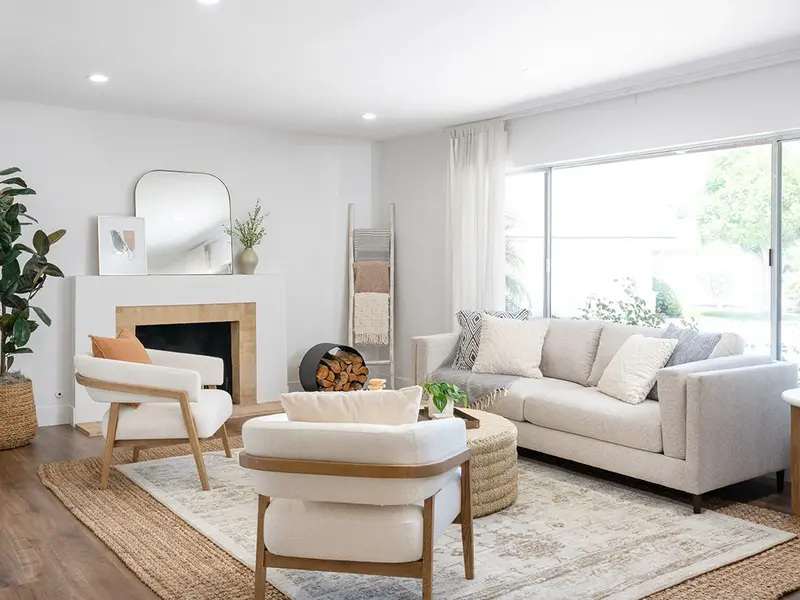
A finished NP Rugs custom piece installed on-site. This is what the 28–34 week production journey delivers.
Ready to Request a Quote?
You don’t need a finished design to start. Our in-house design team will take whatever you have – a rough sketch on paper, a reference image, a color palette, a mood board, a verbal description – and produce a full digital rendering of your rug, free of charge. No commitment required at that stage.
Once you’ve approved the rendering, we’ll issue a detailed quote based on the exact specification. From there, production begins only when you’re ready.
Bring what you have. A room dimension, a material preference, a budget target, an image you found online – any of these is enough to start the conversation.
If you want to understand the full production process before requesting a quote, our sourcing guide for trade buyers covers it step by step.
NP Rugs is a GoodWeave and Label STEP certified hand-knotted rug manufacturer based in Kathmandu, Nepal. Established 1991. Production capacity: 5,000+ sqm/month. We export to the US, Europe, and Australia.