
Most first-time Nepal buyers don’t hesitate because of price or quality. They hesitate because nobody has clearly explained what happens after the rug leaves the factory.
What HTS code applies? Is it actually duty-free, like some older sourcing guides still claim? What documents does the manufacturer provide, and what falls on you? Do you need a customs broker, or can you clear the shipment yourself?
NP Rugs has exported hand-knotted rugs to the US since 1991. This is the current, honest answer – including a change that took effect at the start of this year and that most sourcing content online has not caught up with yet.
Is It Still Duty-Free to Import Rugs from Nepal? (The 2026 Answer)
No – and if you’ve read that it is, that information is out of date.
Hand-knotted wool rugs from Nepal, classified under HTS 5701.10, carry a 0% base (MFN) duty rate on paper. For years, many of these products also qualified for duty-free US entry under the Nepal Trade Preference Program (NTPP), a scheme covering 77 Nepali products including certain carpets.
The NTPP expired on 31 December 2025 and was not renewed for 2026, despite Nepal formally requesting an extension through the Nepal-US Trade and Investment Framework Agreement. Separately, Nepal – like most US trading partners – is now subject to the US reciprocal tariff baseline of approximately 10%, in effect since 2025.
The result: the real, effective landed duty on a hand-knotted rug from Nepal in 2026 is approximately 10%, not zero. That is the number to build into your landed-cost math, not the 0% MFN base rate on its own.
Last verified: July 2026. Trade policy in this area has moved twice in the last twelve months. Confirm the current rate with a licensed customs broker before finalizing an order – and if you’re reading this more than a few months after publish, ask us directly, since this is exactly the kind of number that changes without much warning.
Why publish a number that makes Nepal sourcing look more expensive rather than less? Because buyers who plan around the real duty rate don’t get an unpleasant surprise at customs. Buyers who plan around an outdated “duty-free” claim do. For context on how this affects total landed cost against FOB pricing, see our custom rug pricing guide.
HTS Classification: Which Code Applies
Hand-knotted wool and fine-animal-hair carpets fall under HTS 5701.10, with statistical suffixes distinguishing construction and certification status. NP Rugs’ export documentation generally cites one of two lines:
| HTS Code | Applies To | Base (MFN) Duty |
|---|---|---|
| 5701.10.1300 | Certified hand‑loomed / folklore hand‑knotted product | Free |
| 5701.10.4000 | Hand‑knotted wool carpet, not separately certified handloomed | Free |
Both lines carry a 0% base rate – the classification affects statistical reporting and, in some cases, eligibility for specific preference programmes, more than it affects the duty you actually pay in 2026 (since the reciprocal tariff applies regardless of which of these two lines is used).
Do not assume the code from a previous shipment or a generic guide applies to your product. Confirm the exact classification with your customs broker, based on your rug’s construction and certification status. NP Rugs states the classification used on the commercial invoice and shipping documents for every order.
Required Import Documentation
Every NP Rugs shipment to the US ships with a complete documentation package:
| Document | Who Provides It | Purpose |
|---|---|---|
| Commercial invoice | NP Rugs | States value, quantity, and HTS classification for customs valuation |
| Packing list | NP Rugs | Itemises contents, weights, and carton counts against the invoice |
| Bill of lading (sea) / Air waybill (air) | Freight forwarder, referencing NP Rugs export docs | Proof of shipment and title document for cargo release |
| Certificate of origin | NP Rugs | Confirms Nepal as country of manufacture for customs duty treatment |
| GoodWeave certification | NP Rugs, where applicable | Confirms child‑labour‑free production for buyers who require it |
| Customs entry / import declaration | Buyer or customs broker | Filed with US Customs and Border Protection (CBP) to release the shipment |
What NP Rugs issues directly: commercial invoice, packing list, certificate of origin, and GoodWeave documentation where applicable – all included with every shipment at no extra cost.
What the buyer arranges: the customs entry itself, typically through a licensed customs broker, along with international freight and marine insurance from the FOB point.
Certificate of Origin: Self-Certification
A certificate of origin confirms where a shipment was manufactured, which customs authorities use to apply the correct duty treatment and, historically, preference-programme eligibility.
NP Rugs provides self-certification forms, depending on the buyer’s import authority requirements:
- Self-certification – a certificate of origin statement issued directly by NP Rugs on company letterhead, accepted by many customs authorities where a formal Form A is not required
Tell us which your customs broker requires when you place your order – this is confirmed at the quote stage, not left until the shipment is ready to leave.
Freight Options: Sea vs. Air
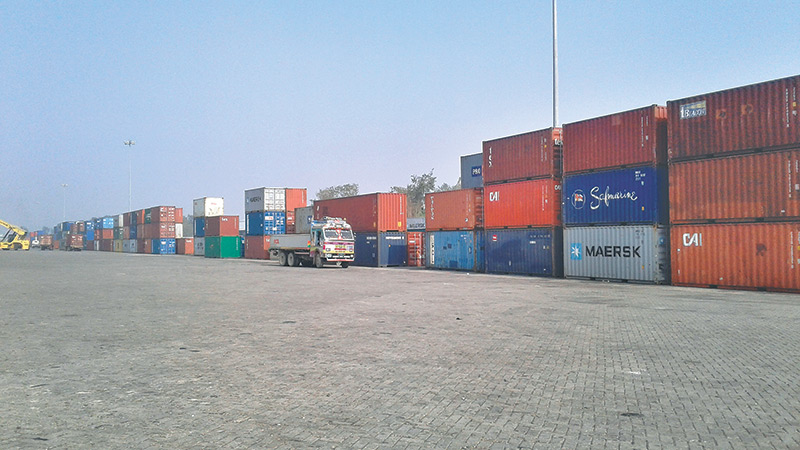
Sea freight is the standard for volume orders – full containers or consolidated LCL (less-than-container-load) shipments.
| Route | Typical Transit Time |
|---|---|
| Nepal → US West Coast (LA / Long Beach) | 28–35 days |
| Nepal → US East Coast (New York / Savannah) | 35–45 days |
Air freight is used for samples, urgent single pieces, or time-sensitive commercial projects. It costs significantly more per kilogram than sea freight but cuts transit to days rather than weeks – worth it for a strike-off sample or a piece needed for a specific installation deadline, rarely worth it for a full container order.
NP Rugs ships FOB Kathmandu or FOB Kolkata. From that point, the buyer arranges international freight, marine insurance, and inland delivery. For the full process from enquiry through FOB handover, see our step-by-step custom order guide.
Customs Broker vs. Self-Clearance
Self-clearance – filing your own customs entry without a broker – is legally permitted. For a first-time Nepal shipment, we don’t recommend it.
A licensed customs broker with textile or carpet import experience:
- Confirms the correct HTS classification for your specific product
- Calculates the actual duty owed, including current reciprocal tariff treatment
- Files the entry with CBP and manages any examination or documentation query
- Knows what CBP flags on carpet shipments specifically, and how to avoid triggering it
The broker’s fee is small relative to the cost of a misclassified entry, a demurrage charge from a delayed container, or a shipment held for additional review. NP Rugs does not endorse a specific broker, since the right choice depends on your port of entry and existing logistics relationships – but if you don’t already have one, ask us. We can refer you to freight forwarders and brokers with direct Nepal experience.
Importing Samples: What’s Different
Strike-off samples and small reference pieces are usually shipped by air, and are subject to the same duty treatment as a full order – value determines duty, not shipment size. A low declared value does not exempt a sample shipment from classification or documentation requirements; it simply means the duty owed is proportionally small.
Keep the same documentation standard for samples as for full orders: commercial invoice, packing list, and accurate declared value. This matters more than it sounds like it should – see the mistakes section below.
Door-to-Door Timeline
| Stage | Time |
|---|---|
| FOB handover in Nepal | — |
| Sea freight transit | 28–45 days (route‑dependent) |
| Customs entry and clearance | 3–7 days, longer if additional examination is triggered |
| Inland delivery to US warehouse | 2–5 days |
| Total, FOB to US warehouse | 5–8 weeks |
This is in addition to the production and strike-off timeline covered in our custom order guide – production and FOB handover typically take 28-32 weeks from initial enquiry, with the import process above starting only once the rug is on the water.
Three Mistakes First-Time Importers Make
1. Using the wrong HTS code.
Hand-knotted rugs from Nepal have a specific classification. Using a generic “carpet” code or copying a code from a different product triggers incorrect duty calculation and can delay clearance while CBP requests a correction.
2. Skipping the customs broker.
Self-clearance is possible. It is also where most first-time delays and unexpected costs happen – a rejected entry, a missing document, a classification query nobody is available to answer quickly. A broker with textile experience costs less than the mistakes it prevents.
3. Undervaluing the goods on the commercial invoice.
CBP cross-references declared values against comparable imports. A declared value that looks low for the size, material, and construction described flags the shipment for examination – which slows clearance rather than saving money. Declare the actual transaction value.
Pre-Shipment Checklist: What to Have Ready
Before your first Nepal rug shipment arrives at a US port, confirm you have:
- Correct HTS classification confirmed with your customs broker
- Commercial invoice matching the accurate transaction value
- Packing list matching the commercial invoice
- Bill of lading or air waybill
- Certificate of origin (Form A or self-certification, confirmed with your broker which your import authority requires)
- GoodWeave certification documentation, if required by your buyers or retail partners
- A licensed customs broker engaged before the shipment departs Nepal, not after it arrives
- Marine insurance arranged for the transit period
- Inland delivery arranged from the port of entry to your warehouse
Every item on this list ships with an NP Rugs order except the broker engagement, marine insurance, and inland delivery – those are arranged on the buyer’s side.
Frequently Asked Questions
Is it still duty-free to import rugs from Nepal to the US in 2026?
No. The Nepal Trade Preference Program expired 31 December 2025 and was not renewed. Hand-knotted wool rugs carry a 0% MFN base rate but are now subject to the US reciprocal tariff baseline of approximately 10% — the real effective duty in 2026 is approximately 10%, not zero.
What HTS code applies to hand-knotted rugs from Nepal?
Generally HTS 5701.10, with the specific statistical suffix (5701.10.1300 or 5701.10.4000) depending on certification and construction. Confirm the exact line with your customs broker rather than assuming one code applies universally.
What documents do I need to import a rug from Nepal?
A commercial invoice, packing list, bill of lading or air waybill, certificate of origin, and GoodWeave documentation where applicable. NP Rugs provides all of these with every shipment.
Do I need a customs broker?
Not legally, but we recommend one for a first-time shipment. A broker with textile experience handles classification, duty calculation, and entry filing, and knows what CBP looks for on carpet imports specifically.
How long does it take to import a rug from Nepal to the US?
From FOB handover, plan for 5-8 weeks including sea freight, customs clearance, and inland delivery — on top of the 28-32 week production and sampling timeline if this is a custom order.
What is a certificate of origin, and does NP Rugs provide one?
A document confirming Nepal as the country of manufacture, used for correct customs duty treatment. NP Rugs provides a Form A or self-certified version with every shipment, depending on your import authority’s requirements.
Ready to Import Your First Shipment from Nepal?
The paperwork is not the obstacle it looks like from the outside – it just needs to be done correctly, once, with the right documents and the right classification from the start.
Book a free sourcing consultation and we’ll walk through your specific product, confirm the HTS classification and current duty treatment, and send you the documentation checklist for your first shipment.
Book Your Free Sourcing Consultation →
Or reach us directly:
- Email: info@nprugs.com
Related reading: